Same Query, Different Sources: Why AI Platforms Disagree on Where to Get Answers
Search OS
Same Query, Different Sources: Why AI Platforms Disagree on Where to Get Answers
The 13.7% Problem: Why Getting Cited in One AI Search Doesn't Mean You'll Appear in Another
A user types a question into Google AI Mode. Then types the exact same question into ChatGPT. Both systems generate confident, detailed answers. Both cite sources. But here's the twist: those sources almost never overlap.
Recent research analyzing over 730,000 AI-generated responses found that Google AI Mode and ChatGPT agree on what to say 86% of the time—yet they cite the same URLs only 13.7% of the time.
That gap has profound implications for anyone trying to get their content surfaced in AI search. You cannot assume that ranking in one AI system means visibility in another. Each platform has its own crawl preferences, citation logic, and source selection behavior.
This article breaks down what the latest studies reveal about AI citation patterns, why platforms diverge so dramatically, and what structural changes actually move the needle on multi-platform AI visibility.
The Citation Speed Gap: Why Timing Varies by Platform
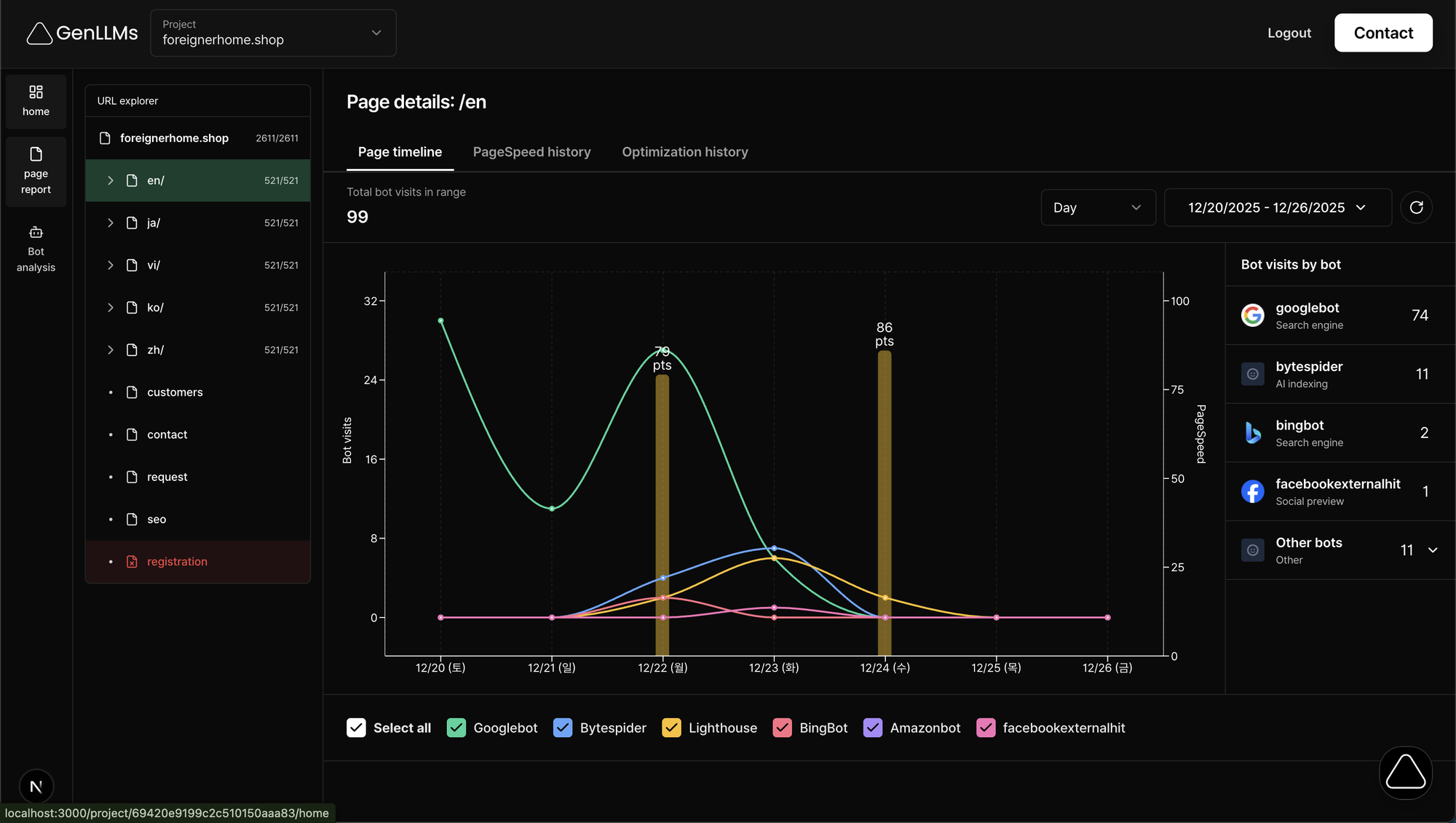
Page details: /en
Navigation Tabs
- Page timeline
- PageSpeed history
- Optimization history
- Total bot visits in range
- 99
- Date Range
- 12/20/2025 - 12/26/2025
Bot visits and PageSpeed Chart
| Date | Googlebot (Visits) | Bytespider (Visits) | Lighthouse (PageSpeed) | BingBot (Visits) | Amazonbot (Visits) | facebookexternalhit (Visits) |
|---|---|---|---|---|---|---|
| 12/20 (토) | 30 | 0 | 0 | 0 | 0 | 0 |
| 12/21 (일) | 11 | 0 | 0 | 0 | 0 | 0 |
| 12/22 (월) | 27 | 4 | 79 pts | 2 | 0 | 0 |
| 12/23 (화) | 2 | 7 | 6 | 1 | 7 | 0 |
| 12/24 (수) | 0 | 2 | 86 pts | 0 | 0 | 0 |
| 12/25 (목) | 0 | 0 | 0 | 0 | 0 | 0 |
| 12/26 (금) | 0 | 0 | 0 | 0 | 0 | 0 |
| Bot Name | Category | Visits |
|---|---|---|
| googlebot | Search engine | 74 |
| bytespider | AI indexing | 11 |
| bingbot | Search engine | 2 |
| facebookexternalhit | Social preview | 1 |
| Other bots | Other | 11 |
URL explorer
- foreignerhome.shop 2611/2611
- en/ 521/521
- ja/ 521/521
- vi/ 521/521
- ko/ 521/521
- zh/ 521/521
- customers
- contact
- request
- seo
- registration
Search OS Dashboard When new content goes live, how fast do AI platforms pick it up? The answer depends entirely on which platform you're asking about.
A controlled experiment publishing 81 test pages found that Google AI Mode cited 36% of those pages within 24 hours of publication. ChatGPT search, by contrast, cited only 8% in the same window—more than three times slower. But speed isn't the whole story. What matters just as much is stability.
Google AI Mode's citations proved remarkably volatile. By day seven, 56% of the test pages had been cited at least once. But that number fluctuated wildly in subsequent days. By day 30, only 26% of pages remained cited—a drop of more than 50% from peak.
ChatGPT search behaved differently. Citations accumulated gradually: 10% on day one, 17% by day seven, 35% by day fourteen, and 42% by day thirty. Pages that got cited tended to stay cited, and new pages kept appearing in results over time.
What does this mean practically?
For Google AI Mode, getting an initial citation is relatively easy if your domain carries authority. Keeping that citation requires something else entirely: consistent signals that your content remains current and relevant.
For ChatGPT search, patience matters. Visibility builds more slowly, but once you're in, you tend to stay.
Platform Divergence in Source Selection
The 13.7% citation overlap figure deserves more unpacking. When two AI systems answer the same query by citing almost entirely different sources, it tells us something fundamental: these systems are not merely reformatting the same underlying index. They're making independent decisions about what counts as trustworthy.
Analysis of 540,000 query pairs revealed clear preference patterns.
Wikipedia appeared in 28.9% of AI Mode citations but only 18.1% of AI Overview citations. Quora was cited 3.5 times more often in AI Mode than in AI Overviews. Health-focused websites showed up nearly twice as frequently in AI Mode. YouTube held the top position in AI Overviews, getting cited more often than encyclopedic sources.
The pattern suggests AI Mode gravitates toward encyclopedic and detailed informational content when constructing longer responses. AI Overviews, optimized for brevity, lean more heavily on video content and community-driven platforms.
Neither preference is inherently better. But if your content strategy assumes a single optimization approach will work everywhere, these numbers should give you pause.
Semantic Agreement Despite Source Disagreement
Here's where things get counterintuitive. Despite citing different sources and using different words (only 16% word-level overlap), AI Mode and AI Overviews produced semantically similar responses 86% of the time.
Both platforms are converging on the same conclusions through different paths. They agree on what to say. They just disagree on who said it first.
Google's own documentation confirms that both systems use "query fan-out"—a technique that runs multiple related searches to find supporting content while responses are generated. Since each system uses different underlying models and selection criteria, the same fan-out process naturally surfaces different URLs.
Think of it like two expert analysts answering the same question. They reference different studies, use different phrasing, and cite different sources—but arrive at the same core insight.
This has an important implication: topical authority matters more than exact phrasing. If you build comprehensive, accurate content around a subject, you increase the odds that at least one AI system will find and cite you—even if you can't predict which one.
The Freshness Advantage in AI Citations
Content age plays a measurable role in what gets cited. Analysis of 17 million citations found that AI-cited content is 25.7% fresher on average than content appearing in traditional organic search results.
Platform-by-platform, the patterns diverge again:
ChatGPT shows the strongest preference for recent content, citing URLs that are 393 to 458 days newer than what appears in Google's organic results. Perplexity and Gemini also favor fresher content, though less dramatically. Google's AI Overviews, interestingly, behave most like traditional search—sometimes citing content that's slightly older than what ChatGPT prefers.
Freshness signals matter differently depending on which AI platform you're targeting.
For ChatGPT visibility, regular content updates aren't optional—they're structural requirements. For Google AI Overviews, the calculation is more nuanced. Traditional SEO signals like authority and backlinks still carry weight.
Why Many Pages Never Get Cited at All
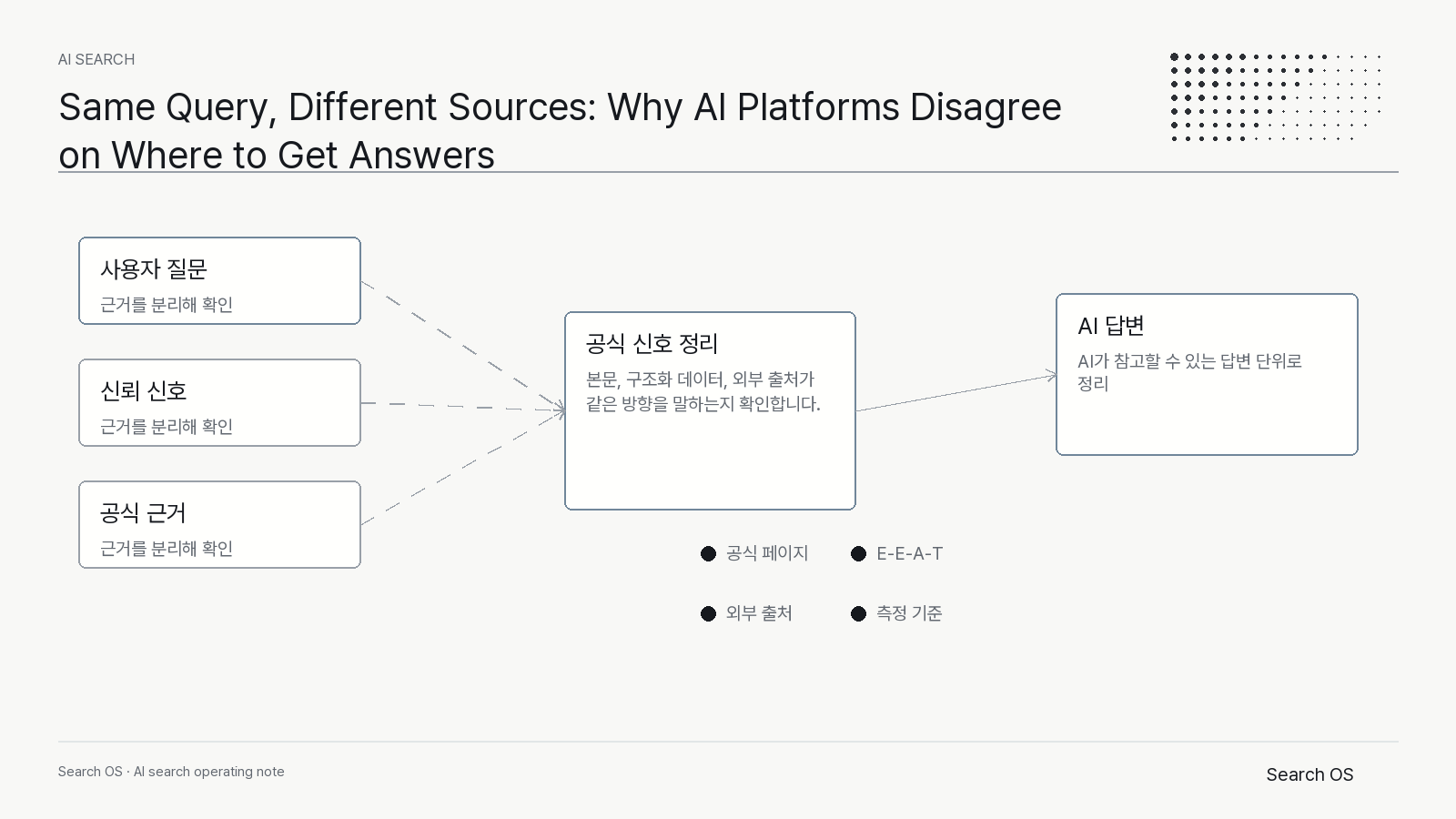
AI SEARCH
Same Query, Different Sources: Why AI Platforms Disagree on Where to Get Answers
| 단계 | 항목 | 설명 |
|---|---|---|
| 입력 데이터 | 사용자 질문 | 근거를 분리해 확인 |
| 입력 데이터 | 신뢰 신호 | 근거를 분리해 확인 |
| 입력 데이터 | 공식 근거 | 근거를 분리해 확인 |
| 처리 과정 | 공식 신호 정리 | 본문, 구조화 데이터, 외부 출처가 같은 방향을 말하는지 확인합니다. |
| 결과 출력 | AI 답변 | AI가 참고할 수 있는 답변 단위로 정리 |
공식 신호 정리 기준
- 공식 페이지
- 외부 출처
- E-E-A-T
- 측정 기준
Search OS · AI search operating note
Search OS
Even after 30 days, the study's best-case scenario saw only 59% of test pages cited in Google AI Mode and 42% in ChatGPT search. That means roughly half of all content—published on a high-authority domain with strong SEO fundamentals—never became a source for AI answers.
Why the gap? The obvious factors apply: competition, topical saturation, search intent mismatch. But there's a less-discussed factor that explains why technically strong content still fails to surface.
AI crawlers don't just need to find your content. They need to parse it efficiently. If your page structure makes it difficult for bots to extract clean, structured information, you're losing visibility before the ranking algorithm even kicks in.
This is where most optimization strategies fall short. They focus on what to write without asking whether bots can actually read it.
What Search OS Does Differently
Search OS approaches this problem from the infrastructure layer. Instead of treating AI visibility as an afterthought, the system ensures bots can consume your content before worrying about how algorithms rank it.
The platform creates bot-first pages—structures specifically designed for AI agent readability. Automatic schema generation produces valid JSON-LD markup without manual coding. Every bot interaction gets logged, giving you full bot log visibility to see exactly what crawlers encounter when they hit your pages.
The result? 300× faster crawling. 0 crawl failures. In the same time window, bots ingest 300× more information.
Operationally, Search OS works across Shopify, Wix, Substack, and similar platforms. Keyword and prompt prediction surfaces the queries where your content has the best chance of appearing. And the system runs a continuous optimization loop—analyzing bot logs, identifying friction points, and adjusting until target pages reliably surface across AI search platforms.
For teams stretched thin on technical resources, this translates to an 80% labor cost reduction compared to manual optimization workflows.
Entity Exposure and Brand Visibility
AI Mode responses include roughly 2.5 times more brand and entity mentions than AI Overviews. On average, AI Mode mentions 3.3 entities per response compared to 1.3 for AI Overviews.
But here's what matters for brand visibility: 61% of the time, if a brand appears in an AI Overview, it also appears in AI Mode's longer response. The catch? You'll be sharing space with additional competitors who didn't make the shorter AI Overview cut.
Getting mentioned in AI Overviews is the narrower gate. AI Mode expands that pool but introduces more competitive noise.
There's also a significant blank-space problem. 59% of AI Overviews contain no brands or entities at all. For AI Mode, that figure drops to 35%.
For informational queries where no brand is expected—things like "meditation before bed" or "what is revenue cycle"—no brand gets mentioned. If your business depends on appearing in these informational contexts, you'll need content that establishes topical authority well before the user asks a transactional question.
A Visibility Strategy That Accounts for Platform Divergence
The data points toward a few operational conclusions. First, track AI visibility by platform. Being cited in one system tells you nothing about your presence in another. Monitor each separately.
Second, optimize for semantic authority rather than exact phrases. Both AI Mode and AI Overviews care more about whether you're a credible source on a topic than whether you've repeated specific keywords.
Third, address crawlability before content. If bots can't parse your page efficiently, it doesn't matter how good your content is. Structured data, clean markup, and fast-loading pages aren't nice-to-haves—they're prerequisites.
Fourth, update content strategically. ChatGPT rewards freshness heavily. Google's systems are more forgiving of older content if authority signals are strong. Plan your update cadence accordingly.
Fifth, build infrastructure for continuous optimization. Citation patterns change. Platforms update their models. One-time optimization doesn't cut it. You need a feedback loop that identifies what's working, what's failing, and what needs adjustment.
The Bigger Picture
The fragmentation of AI search means visibility can no longer be treated as a single problem with a single solution. Each platform has its own logic, its own preferences, its own blind spots.
But underneath all the complexity, one requirement remains constant: bots need to be able to read and understand your content before they can cite it. Get that right, and the platform-specific optimizations become refinements rather than foundational fixes.
Get it wrong, and no amount of keyword targeting or freshness updates will compensate for the structural gap.
You just read why 86% of pages never get cited by AI search.
The problem isn't your content. It's that bots can't parse it. Search OS shows you exactly what AI crawlers see when they hit your site—then fixes what's broken. No guesswork. No wasted rewrites.
300× faster crawling. 0 crawl failures. See the difference in your first bot log report. [Get My Free Bot Log Analysis →]