Is Color Me Shop Weak at SEO
Navigation
- Search OS
- Color Me Shop
Is Color Me Shop Weak at SEO
| Category | Read Time | Topic | Source | Description | URL | Copyright |
|---|---|---|---|---|---|---|
| Insights | 6 min read | Japan EC platform guides for search and AI search | Search OS | Color Me Shop has a reputation for being weak at SEO. The basic on-page settings are available. What is hard to see is whether bots fetched your pages and what they read on screen. This article sorts out what you can do from the admin panel and where you need a separate way to check. | searchos.io/en/blog | © 2026 Search OS |
Many shops hear that Color Me Shop is weak at SEO and wonder whether they should migrate. Another common question is how far they need to go to stand level with competitors.
The same claim comes up for Japanese hosted carts in the few-thousand-yen-a-month range in general. In practice, the basic on-page settings are well provided. The weak part is checking how bots read your pages.
This article sorts out the reasons behind the reputation, the countermeasures you can take, the areas the admin panel can't reach, and common misunderstandings.
Conclusion: On-page basics are covered. What's missing is visibility into the layer bots read
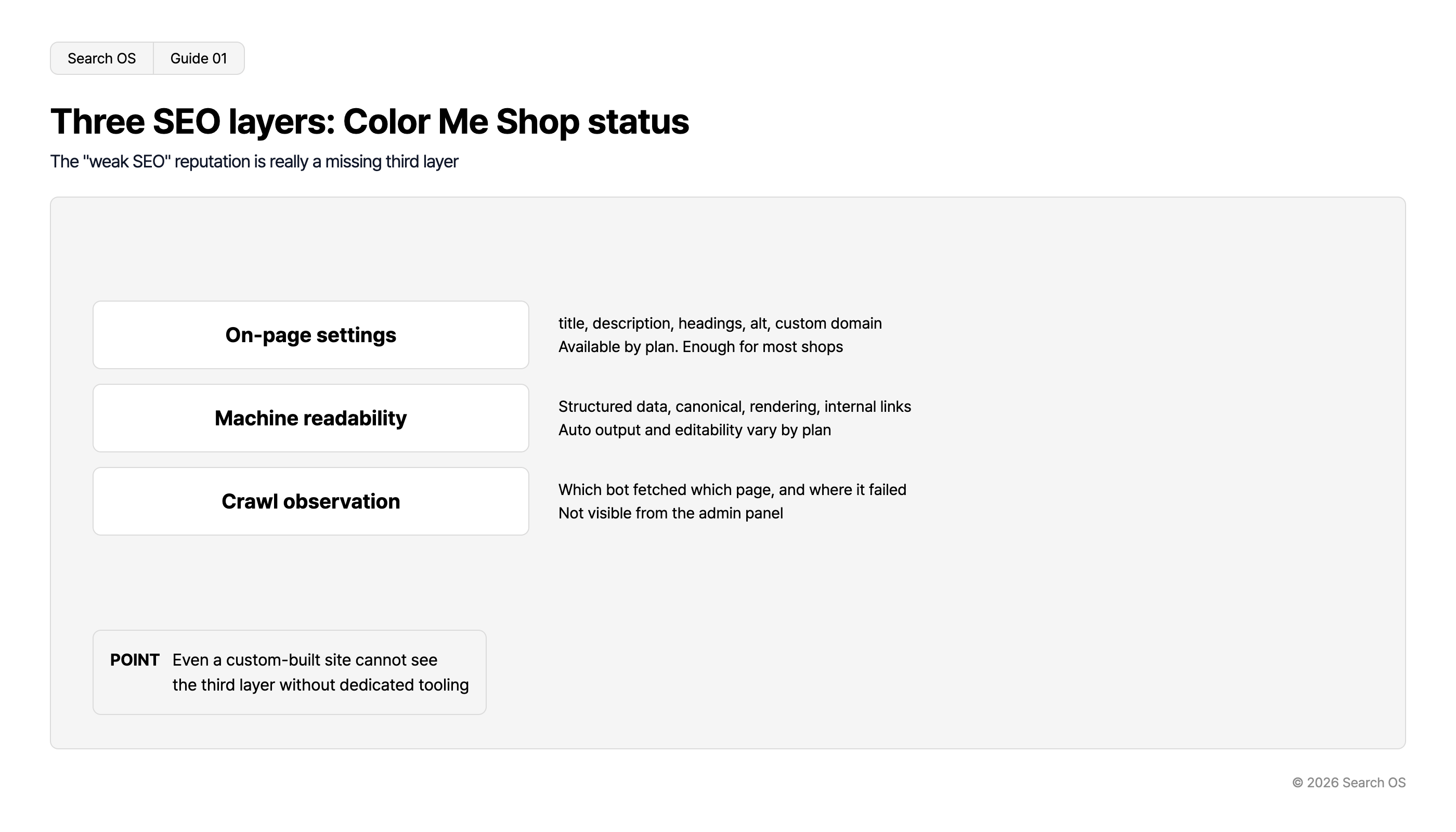
SEO here means the work of being read correctly, cited, and chosen by search engines and AI. Polishing descriptions and checking whether bots could read them are separate tasks. Think in the following three layers.
Layer | What it covers | Status on Color Me Shop |
|---|---|---|
On-page settings | title, meta description, headings, alt, custom domain | Configurable depending on plan. Usually sufficient here |
Machine readability | Structured data, canonical, rendering, internal link structure | Editable through templates. Check the current output first |
Crawl observation | Which bot fetched which page, and where it failed | Not visible from the admin panel. This is what people call "weak" |
Navigation
- Search OS
- Guide 01
Three SEO layers: Color Me Shop status
The "weak SEO" reputation is really a missing third layer
| Layer | Details | Status |
|---|---|---|
| On-page settings | title, description, headings, alt, custom domain | Available by plan. Enough for most shops |
| Machine readability | Structured data, canonical, rendering, internal links | Auto output and editability vary by plan |
| Crawl observation | Which bot fetched which page, and where it failed | Not visible from the admin panel |
POINT Even a custom-built site cannot see the third layer without dedicated tooling
© 2026 Search OS
Most of the "weak" reputation points at the third layer being invisible. Yet even an in-house build can't see it without a dedicated mechanism. This structure is shared by hosted carts in general, not just Color Me Shop.
Key point: Check the screen people see and the state bots read separately. The same applies on Shopify and on WordPress.
Why it's called "weak"
Four reasons come up often. They include the case where product descriptions are packed into images. Separate platform constraints from writing problems.
On free and low-priced plans, URLs sit under a shared domain. Upgrading to a plan that allows a custom domain resolves this.
The template heading structure centers on the product name, so descriptions tend to be thin. This is a matter of how the store writes, not a platform constraint.
Product descriptions tend to depend on images. This is a production habit. Converting them to text resolves it.
There is no way to check crawl or rendering status. This sits outside the platform's scope and needs a separate means.
Three of the four can be fixed through the store's own settings and writing. Only one issue sits outside the platform.
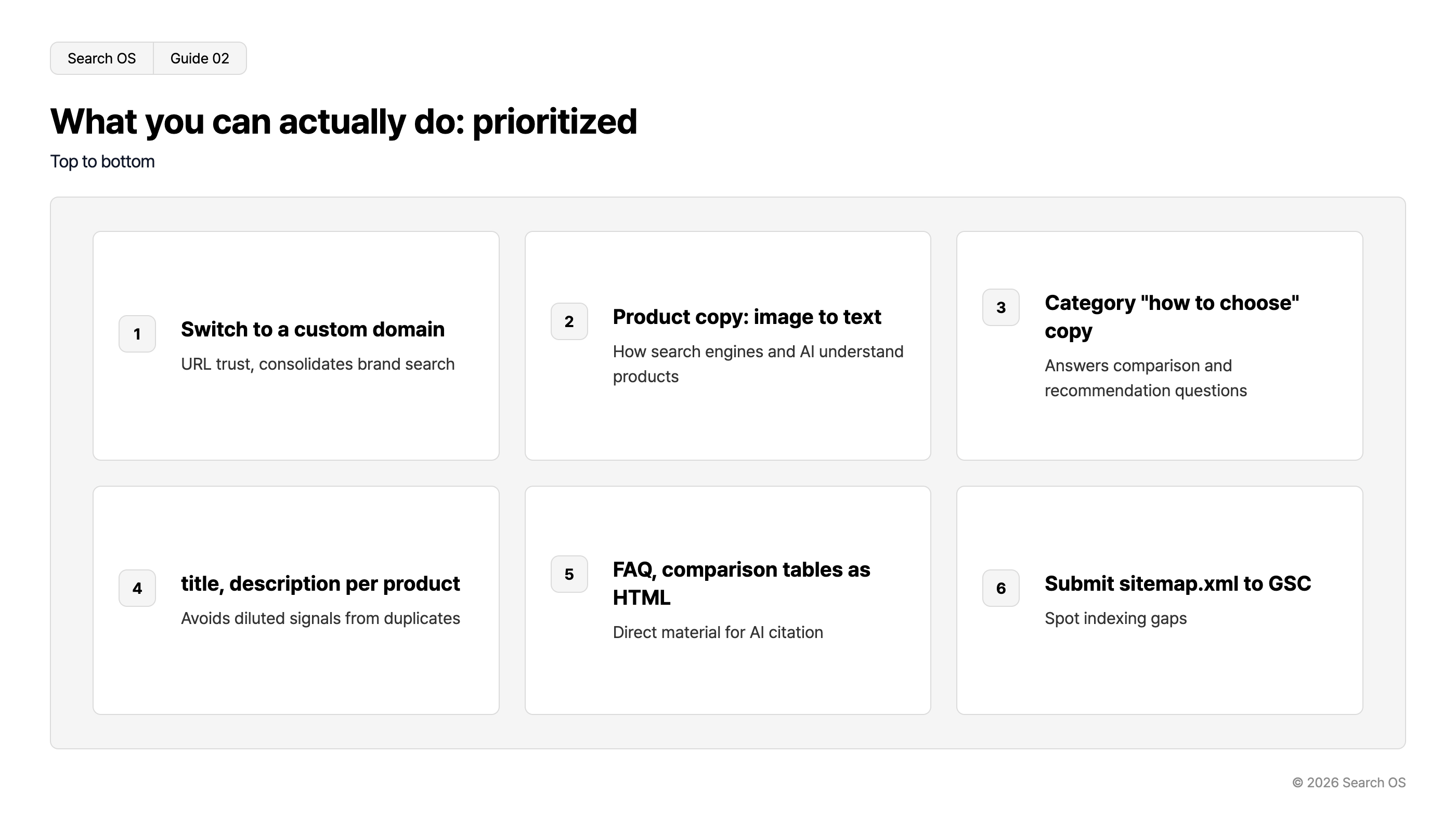
What you can actually do: in priority order
Priority | Action | Expected effect |
|---|---|---|
1 | Switch to a custom domain | URL trust, consolidation of brand searches |
2 | Move product descriptions from images to text | Precondition for search engines and AI to understand products |
3 | Add "how to choose" copy to category pages | Answers comparison and recommendation questions |
4 | Make title and meta description unique per product | Prevents diluted performance from duplicates |
5 | Place FAQs and comparison tables in visible HTML | Direct material for AI citation |
6 | Submit sitemap.xml to Search Console and check coverage | Spot indexing gaps |
Navigation
- Search OS
- Guide 02
What you can actually do: prioritized
Top to bottom
| priority | action | benefit |
|---|---|---|
| 1 | Switch to a custom domain | URL trust, consolidates brand search |
| 2 | Product copy: image to text | How search engines and AI understand products |
| 3 | Category "how to choose" copy | Answers comparison and recommendation questions |
| 4 | title, description per product | Avoids diluted signals from duplicates |
| 5 | FAQ, comparison tables as HTML | Direct material for AI citation |
| 6 | Submit sitemap.xml to GSC | Spot indexing gaps |
© 2026 Search OS
Everything up to here can be handled through the admin panel and template edits. Adding reasons to choose a product on category pages falls within that scope. For many stores, priorities 2 and 3 put them on the same footing as competitors.
What the admin panel can't show you
The following three points can't be confirmed from the admin panel alone, even after you act on them. Adding a product description doesn't tell you whether bots could fetch it. That is checked separately.
Bot logs. Which URLs Googlebot, GPTBot, and PerplexityBot actually fetched, and where they hit errors.
Post-render HTML. Whether product information is complete after JavaScript runs, and whether bots can read it without waiting.
Ongoing structured data validation. Whether the output is still correct after template changes.
These three points need dedicated tools on any platform. Stacking countermeasures without seeing them leaves you unable to judge the effect.
Four common misunderstandings
Misunderstanding | Reality | Why it's a problem |
|---|---|---|
Switching platforms solves SEO | The destination still needs the "layer bots read" separately | Migration costs are spent and the same problem remains |
Adding FAQ structured data gets you into search results | Google has effectively restricted FAQ rich results for general sites | The expected display never appears, and on-page FAQs get neglected |
More products means more exposure | More thin product pages lowers crawl efficiency | More pages drop out of the index |
Image-based descriptions are enough for search | Text inside images isn't read reliably | Drops out of AI recommendation candidates |
Replace "weak" with "not visible"
If your descriptions exist only as images, converting them to text comes first. Before considering a migration, try countermeasures 1 to 6 above. Then check how bots are reading the result.
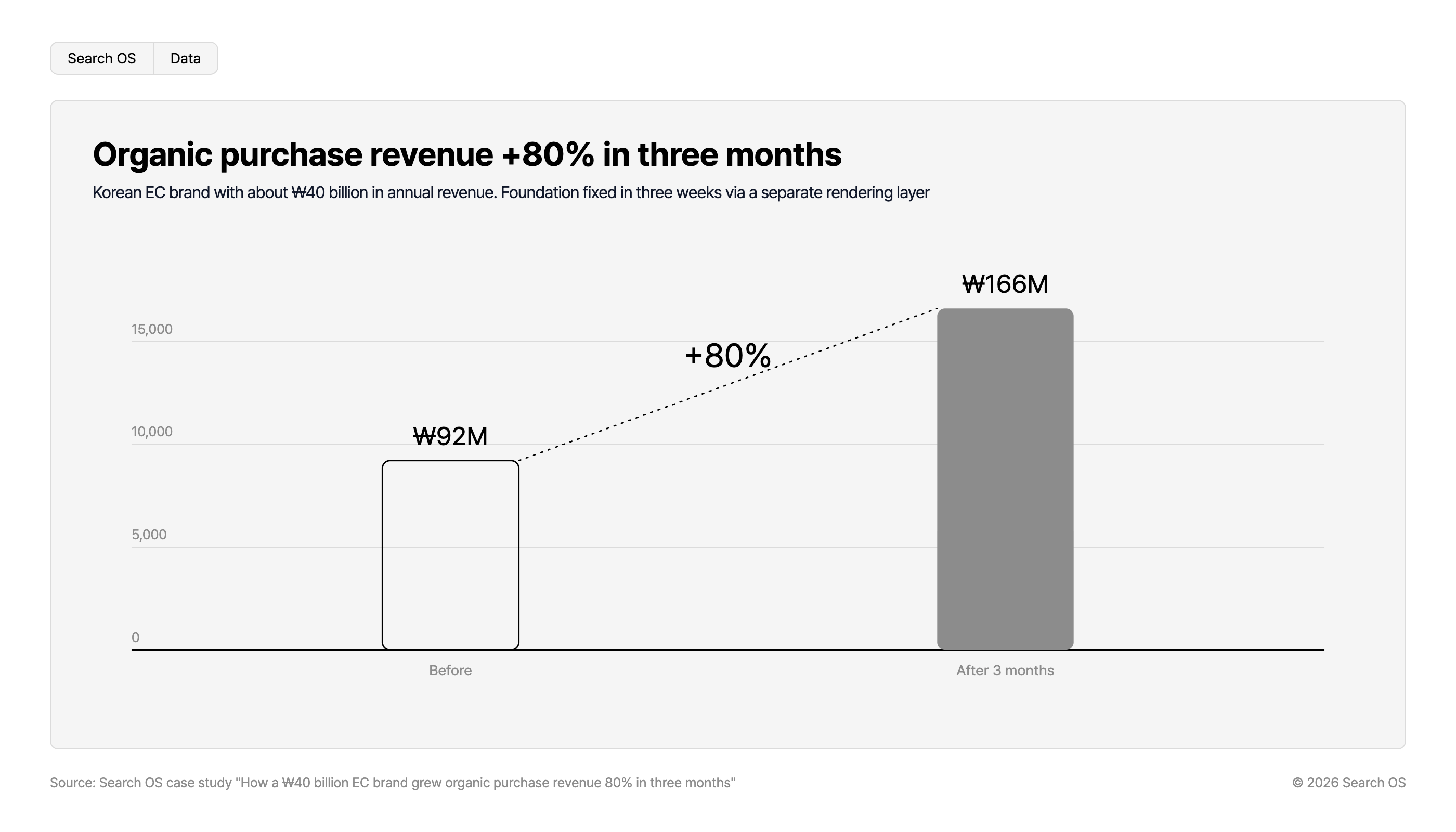
Data point: A Korean ecommerce brand with roughly ₩40 billion (about ¥4 billion) in annual revenue set up its foundation in a separate rendering layer without changing the original code. In three months, organic purchase revenue grew from about ₩92 million to about ₩166 million (+80%).(case study)
Organic purchase revenue +80% in three months
Korean EC brand with about ₩40 billion in annual revenue. Foundation fixed in three weeks via a separate rendering layer
| Period | Revenue | Growth |
|---|---|---|
| Before | ₩92M | |
| After 3 months | ₩166M | +80% |
Source: Search OS case study "How a ₩40 billion EC brand grew organic purchase revenue 80% in three months"
© 2026 Search OS
Search OS supports the operation of this hard-to-see part. It provides the rendering mechanism that assembles the page as a separate layer. Metadata, structured data, sitemap, and canonical are covered too. Your existing pages and checkout stay as they are, and bot logs confirm what was fetched.
Frequently asked questions
Is SEO sufficient once I upgrade to a higher plan?
A custom domain and more freedom to edit HTML become available. Bot logs and rendering checks are a separate matter, though. Whatever the plan, prepare a dedicated means for them.
Is it faster to migrate to Shopify?
After a migration, the same three layers still need handling. Try countermeasures 1 to 6 before deciding. Then confirm which part still isn't visible.
Where do I check whether the countermeasures worked?
Use clicks, impressions, and coverage in Search Console as the baseline. Track AI citations separately, for example with AI Performance in Bing Webmaster Tools.
Related reading
References
Google Search Central: SEO Starter Guide
Google Search Central: FAQ structured data
Google Search Central: JavaScript SEO basics