How Far Can You Trust EC-CUBE SEO Plugins
Navigation
- Search OS
- EC-CUBE
How Far Can You Trust EC-CUBE SEO Plugins
| Category | Read Time | Topic | Source |
|---|---|---|---|
| Insights | 7 min read | Japan EC platform guides for search and AI search | Search OS |
EC-CUBE SEO plugins are reliable enough for meta tags and sitemaps. Structured data has to stay in sync with product data, so having a mechanism that keeps validating the output is more dependable than leaving everything to a plugin. This article covers where plugins fit, what you should own yourself, and how to decide.
- URL
- searchos.io/en/blog
- Copyright
- © 2026 Search OS
Shops running an SEO plugin on EC-CUBE ask whether it is enough, or whether they should implement structured data themselves. Structured data is a notation that describes page content in a form machines can read.
This is a frequent question from developers at mid-sized ecommerce companies on EC-CUBE. The answer depends on the scope. For meta tags, OGP, and sitemaps, a plugin is reliable enough. Structured data is a little different. Before the choice of plugin versus in-house, the center of the decision is whether you have a mechanism that continuously confirms the output is correct. Without one, either implementation repeats the same failures.
This article covers the scope plugins handle and the failures that come from depending on them. It also covers the criteria for choosing an in-house implementation and the operations that keep validation going. Plugin support on EC-CUBE differs by version. Always confirm on the version you use.
Conclusion: Plugins are enough for meta and sitemaps. For structured data, a validation mechanism comes first
Area | Leave to a plugin | Own yourself | Deciding factor |
|---|---|---|---|
title, meta description, OGP | Best fit | Not needed | Whether you can set unique values per product |
sitemap.xml | Limited | The 4 series has no built-in XML sitemap. A plugin or your own generation is required | Accuracy of splitting and lastmod, compatibility on updates |
canonical | Fine | In-house if you have many variant and filter URLs | Structure of duplicate URLs |
Structured data (Product/Offer) | Limited | In-house if price, stock, and variants are dynamic | Sync with product data |
Structured data (Article/BreadcrumbList) | Limited | More stable when held in the template | Whether you have content pages |
Output validation | No | Required | Plugins don't validate |
Navigation
- Search OS
- Guide 01
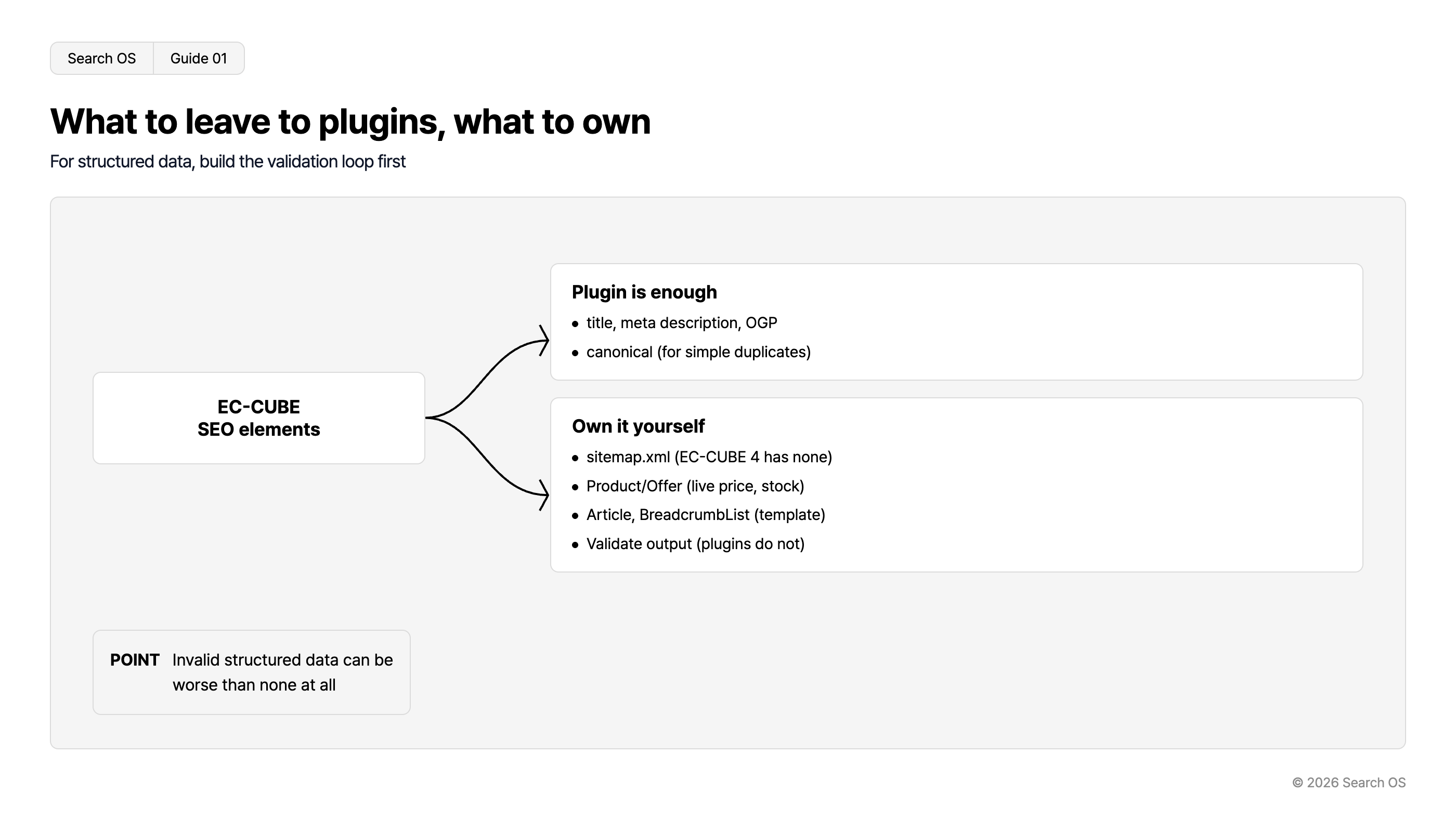
What to leave to plugins, what to own
For structured data, build the validation loop first
EC-CUBE SEO elements
| Strategy | Items |
|---|---|
| Plugin is enough | title, meta description, OGP; canonical (for simple duplicates) |
| Own it yourself | sitemap.xml (EC-CUBE 4 has none); Product/Offer (live price, stock); Article, BreadcrumbList (template); Validate output (plugins do not) |
- POINT
- Invalid structured data can be worse than none at all
© 2026 Search OS
The last row of the table is the main point. Plugins output, but they have no function that keeps confirming the output is correct. When an EC-CUBE core update, a plugin update, or a template change breaks the structured data, nobody notices. This is the most common failure.
Key idea: Invalid structured data can be worse than none. When there is an error, the whole block is ignored. "I thought it was in" leads to a harder outcome than "nothing is in". Confirm first whether a validation mechanism exists.
The scope plugins cover
EC-CUBE SEO plugins generally provide the following. Confirm on the plugin you use.
Template settings for title and meta description by page type
OGP tags
sitemap.xml generation (the EC-CUBE 4 series dropped the sitemap.php that the 2 series had, and doesn't output an XML sitemap by default. A sitemap assumes a plugin or an in-house implementation)
Structured data output on some plugins
These are designed on the assumption of a product structure that follows the standard EC-CUBE templates. The further you depart from the standard, the more the plugin's output drifts from the actual page content.
Drift is most likely in the following three cases.
Products whose price or stock differs by variant (size, color). Which variant's price and stock go into the structured data depends on the plugin's implementation.
Customized templates. Changing the heading structure or the position of product information conflicts with what the plugin expects.
Core and plugin updates. If the output changes after an update, you won't notice without validating. Check the output right after each update.
Failures that come from leaving it to a plugin
Failure | When it happens | Why it's hard to detect |
|---|---|---|
Price in structured data differs from the screen | Sale prices, variant prices | The screen looks normal, so nobody notices |
In-stock product shows as out of stock in structured data | Variant stock, pre-order products | Quietly drops out of AI recommendation candidates |
Structured data stops being output after an update | Core, plugin, or template update | Noticed only once rich results disappear |
Multiple JSON-LD blocks on the same product | Duplicate output from plugin and template | Validation tools show a warning |
Breadcrumbs
- Search OS
- Guide 02
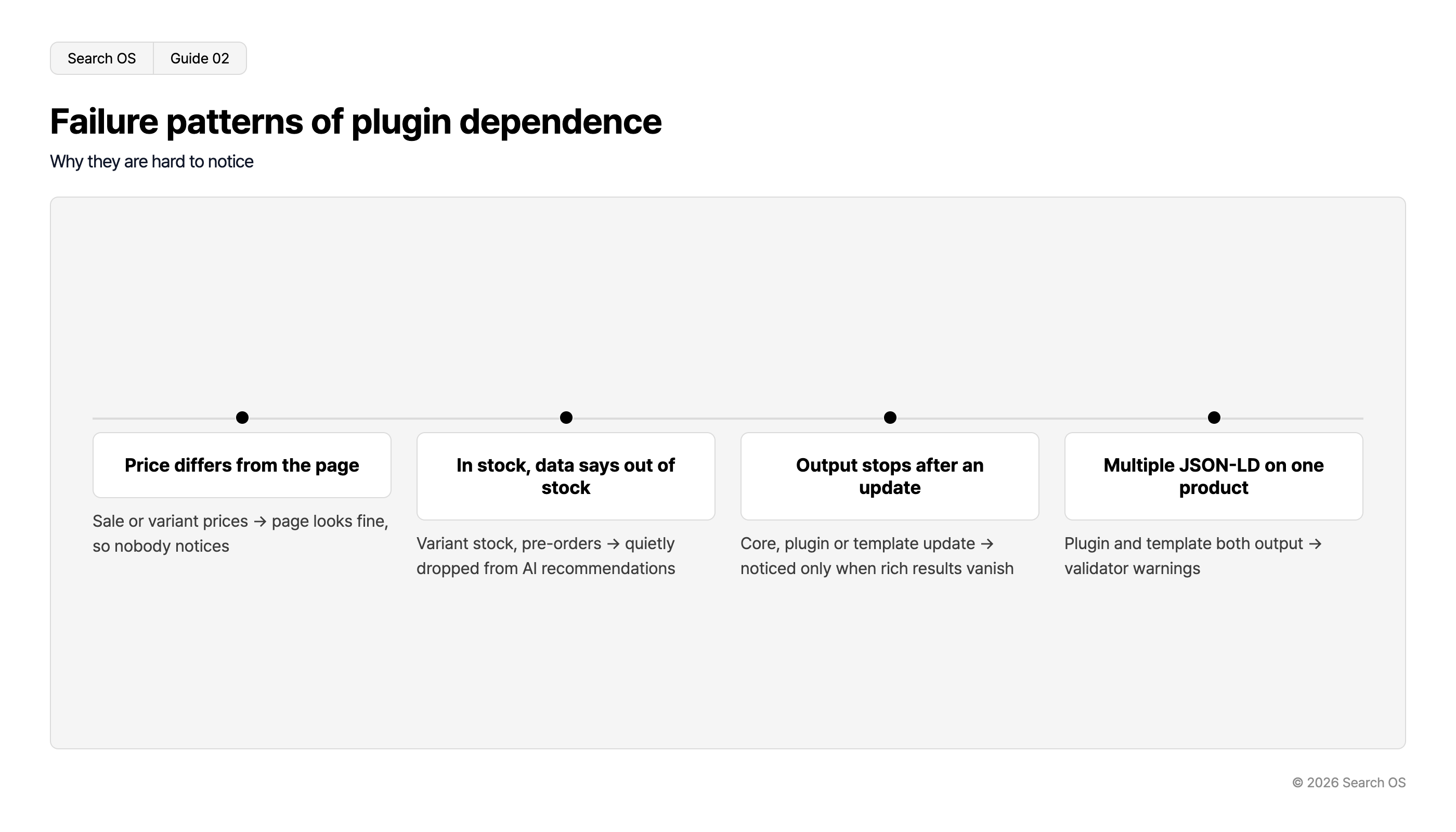
Failure patterns of plugin dependence
Why they are hard to notice
| Pattern | Description |
|---|---|
| Price differs from the page | Sale or variant prices → page looks fine, so nobody notices |
| In stock, data says out of stock | Variant stock, pre-orders → quietly dropped from AI recommendations |
| Output stops after an update | Core, plugin or template update → noticed only when rich results vanish |
| Multiple JSON-LD on one product | Plugin and template both output → validator warnings |
© 2026 Search OS
The same type of failure is reported repeatedly in WordPress plugin environments. Plugin conflicts and theme updates invalidate structured data. EC-CUBE has the same structure. Validate one product page to see whether the failures in the table are happening on your site.
Criteria for owning it yourself
If two or more of the following apply, implement structured data in-house on the template side. Stopping the plugin's output is the more stable choice.
Products whose price or stock varies by variant make up three in ten or more of the catalog
Templates are heavily customized away from the standard
You have content pages (feature pages, articles) and want to output Article
Core and plugin updates happen several times a year
Structured data has broken before
If one or fewer apply, continuing with the plugin's output is fine. In either case, though, a validation mechanism is needed. Merchandise like apparel, where stock moves per size and color, leans toward in-house. Tick the items above and count them.
Operations that keep validation going
The correctness of structured data is decided by today's state, not by the day it was implemented. At minimum, build the following into operations.
Frequency | Task | Method |
|---|---|---|
Every update | Validate one product, one category, and one content page | Rich Results Test |
Weekly | Spot-check that price and stock in structured data match the screen | Sample target URLs |
Monthly | Check error and warning counts in Search Console enhancement reports | Product and breadcrumb items |
Always | Whether bots can fetch product pages | Server logs or bot logs |
Up to a few hundred products, this runs by hand. Past a few thousand, with many variants and frequent updates, the operation itself becomes a burden. Estimate whether you can keep doing it by hand given your product count and update frequency.
The answer lies outside "plugin or in-house"
In an environment like EC-CUBE, where the degree of customization differs from site to site, the method for keeping structured data in sync matters more to the outcome than the method for adding it.
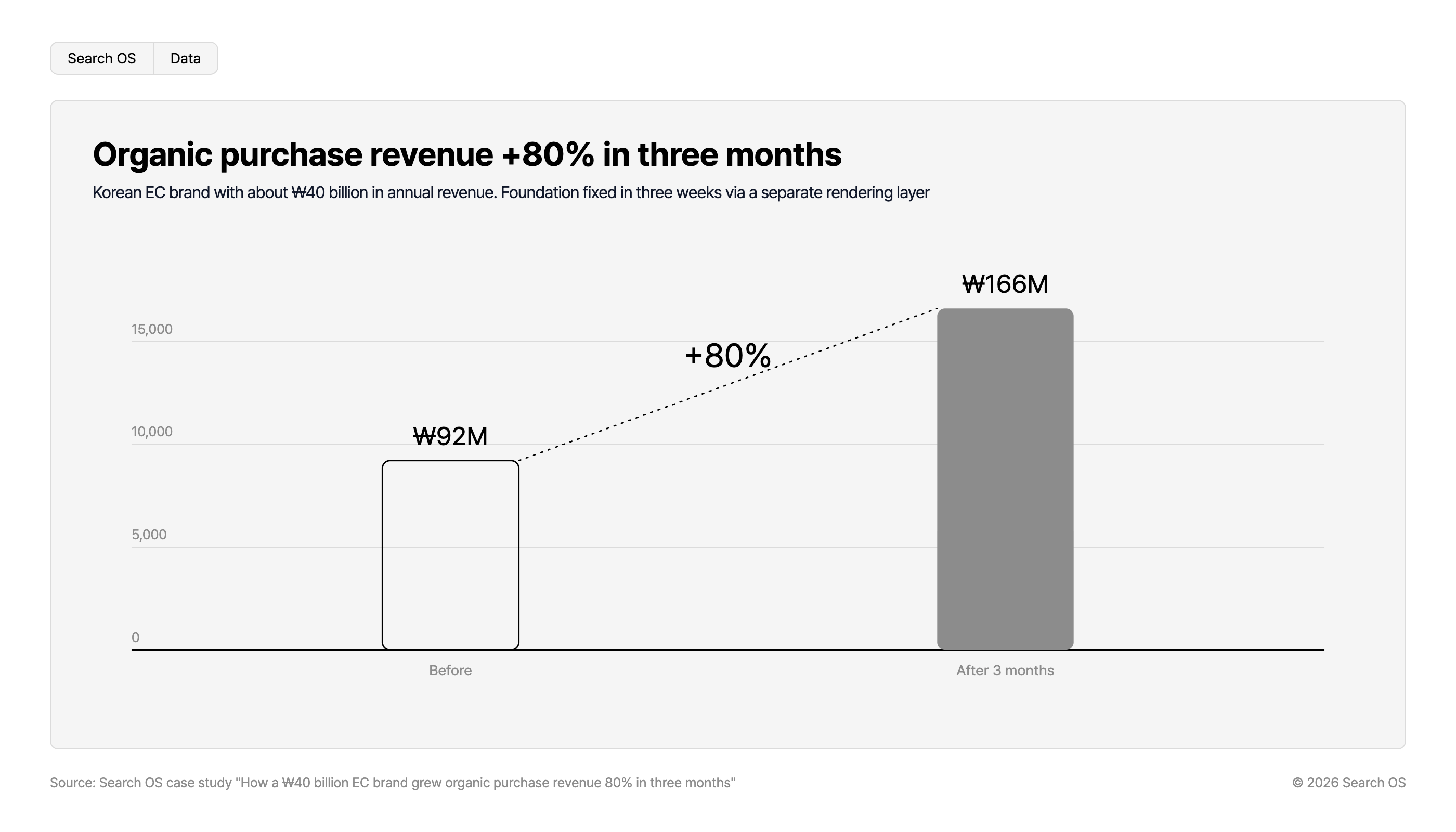
Data point: A Korean ecommerce brand with roughly ₩40 billion (about ¥4 billion) in annual revenue set up its foundation in a separate rendering layer without changing the original code. In three months, organic purchase revenue grew from about ₩92 million to about ₩166 million (+80%).(case study)
Organic purchase revenue +80% in three months
Korean EC brand with about ₩40 billion in annual revenue. Foundation fixed in three weeks via a separate rendering layer
| Period | Revenue | Growth |
|---|---|---|
| Before | ₩92M | |
| After 3 months | ₩166M | +80% |
Source: Search OS case study "How a ₩40 billion EC brand grew organic purchase revenue 80% in three months"
© 2026 Search OS
Search OS doesn't change the EC-CUBE core or its plugins. It provides metadata, structured data, canonical, and sitemap for search engines and AI crawlers as a separate layer. It continuously validates agreement with the visible text. Bot logs also confirm whether Googlebot and GPTBot can actually fetch product pages. Broken output, missing Article, and URLs that fail to fetch are sorted into fix targets. The dividing line is whether the burden of re-validating after every core update can be moved to the operations layer.
Frequently asked questions
Is it a problem to use a plugin and an in-house implementation together?
When the same type of JSON-LD appears twice on the same page, validation tools show a warning. Which one is correct becomes ambiguous. If you combine them, assign each type to one owner so they don't overlap.
Will adding structured data get me cited in AI search?
It is one precondition for citation, but not enough on its own. Agreement with the visible text, body copy that answers the question directly, and a state bots can fetch. Only when all three are in place does the page become a candidate.
Does the same thinking apply to EC-CUBE 2 series sites?
The thinking is the same, but plugin support differs greatly. First confirm which plugins are available on the version you use. Check whether you can add to templates as well.
Related reading
References
Google Search Central: Product structured data
Google Search Central: General structured data guidelines
Google Search Central: Rich result status reports
EC-CUBE: Official site