ecforce: Should Ad Landing Pages Be noindex
Navigation
- Search OS
- ecforce
ecforce: Should Ad Landing Pages Be noindex
- Category
- Guides
- Reading Time
- 6 min read
- Topic
- Japan EC platform guides for search and AI search
When you mass-produce ad landing pages on ecforce, search engines see the main product page plus a whole series of LPs for the same product. The choice is whether to noindex all of them, keep just one, or point them at the main page with canonical. This article sorts out the decision by LP type, where to set it, and how to do so without affecting ad measurement.
- Source
- searchos.io/en/blog
- Copyright
- © 2026 Search OS
If you have built around 30 ad landing pages (LPs) on ecforce, search engines see the main product page plus a large number of LPs for the same product. Shops ask whether they should noindex them and whether that affects their ads.
Ad delivery and measurement are not affected by noindex. noindex is an instruction to search engines not to index the page. It is a separate mechanism from the page's function as an ad landing page and from the ad platform's quality assessment. The decision comes down to one thing: which page you want to show in search. Having the main product page and 30 LPs indexed for the same product spreads the signal thin. There is also the risk that an unintended LP shows up in search results.
This article lays out the decision by LP type, when to use noindex versus canonical, where to set it, and how to check afterward. canonical is the marker that tells search engines which URL is the primary one.
Conclusion: Ad-only LPs get noindex. Keep just one LP you also want in search, and point the rest to the main page with canonical
LP type | Treatment in search | Setting |
|---|---|---|
Ad-only (mass-produced LPs with different offers or angles) | Don't show | noindex |
LP built as a landing spot for search (includes how to choose, comparisons) | Show | index. Separate its role from the main product page |
LP with nearly the same content as the main product page | Don't show | canonical to the main product page |
Limited-time campaign LP | Don't show | noindex. Redirect to the main page after it ends |
Affiliate LP | Don't show | noindex |
Breadcrumbs
- Search OS
- Guide 01
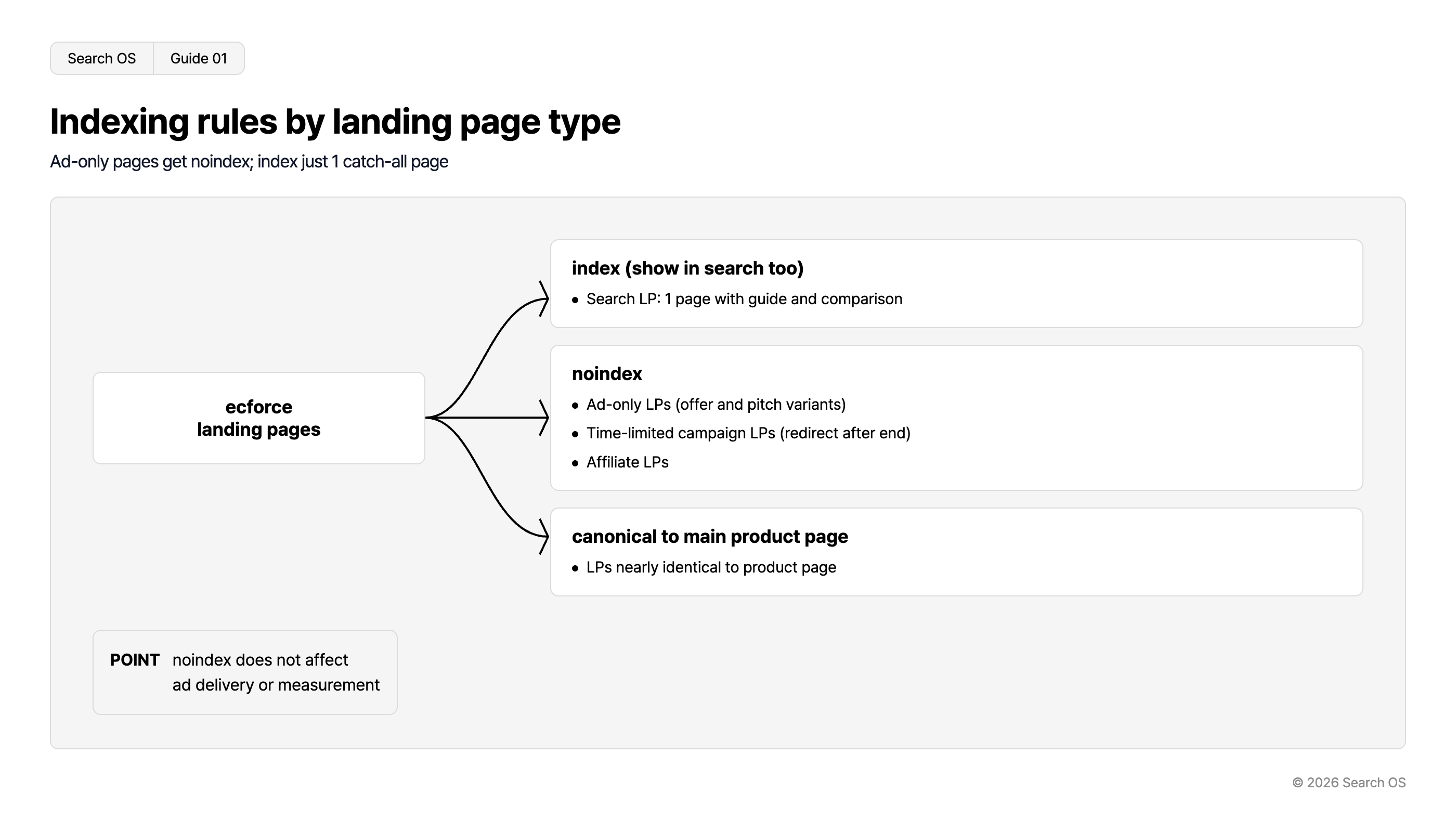
Indexing rules by landing page type
Ad-only pages get noindex; index just 1 catch-all page
| Category | Indexing Rule | Target Pages |
|---|---|---|
| ecforce landing pages | index (show in search too) | Search LP: 1 page with guide and comparison |
| ecforce landing pages | noindex | Ad-only LPs (offer and pitch variants), Time-limited campaign LPs (redirect after end), Affiliate LPs |
| ecforce landing pages | canonical to main product page | LPs nearly identical to product page |
- POINT
- noindex does not affect ad delivery or measurement
© 2026 Search OS
Key idea: An ad LP is a page for people who clicked an ad. It is not a page for people who search. A page with a different role doesn't need to appear in search. Keeping it out lets the signal gather on the main page. Start by sorting your LPs by who each page is for.
When to use noindex versus canonical
Instruction | Meaning | When to use |
|---|---|---|
noindex | Don't index this page. No signal consolidation | LPs that don't need to be in search and whose content differs from the main page (pitch-focused) |
canonical | The official URL is over there. Consolidate signal to it | LPs with nearly the same content as the main product page, where you want the signal on the main page |
noindex + canonical | Contradictory combination | Don't use |
Specifying noindex and canonical together sends search engines a contradictory instruction: treat a page you shouldn't index as the canonical one. Which one wins becomes unstable. Use only one of the two on a page.
Where to set it
First, check whether ecforce's LP admin screen lets you set noindex or canonical per LP. If it does, that is all you need. If not, write the meta tag inside the head of the LP template. Check the ecforce specifications for what can be set.
How to check:
Open the target LP and search the source for
noindexorrel="canonical"tagsConfirm the intended instruction is present
In URL Inspection in Search Console, confirm the LP shows as "Excluded by noindex" or that the canonical is the main page
Effect on ad measurement
Concern | Reality |
|---|---|
noindex stops ads from being delivered | It doesn't. Ads are delivered to the URL you specify |
The ad quality score drops | noindex is outside quality assessment. LP content and speed are what count |
Conversion tracking stops | It doesn't. Tracking tags are unrelated to noindex |
Blocking the LP in robots.txt | Also blocks the ad platform's crawler and can affect quality assessment. Don't use robots.txt |
Breadcrumbs
- Search OS
- Guide 02
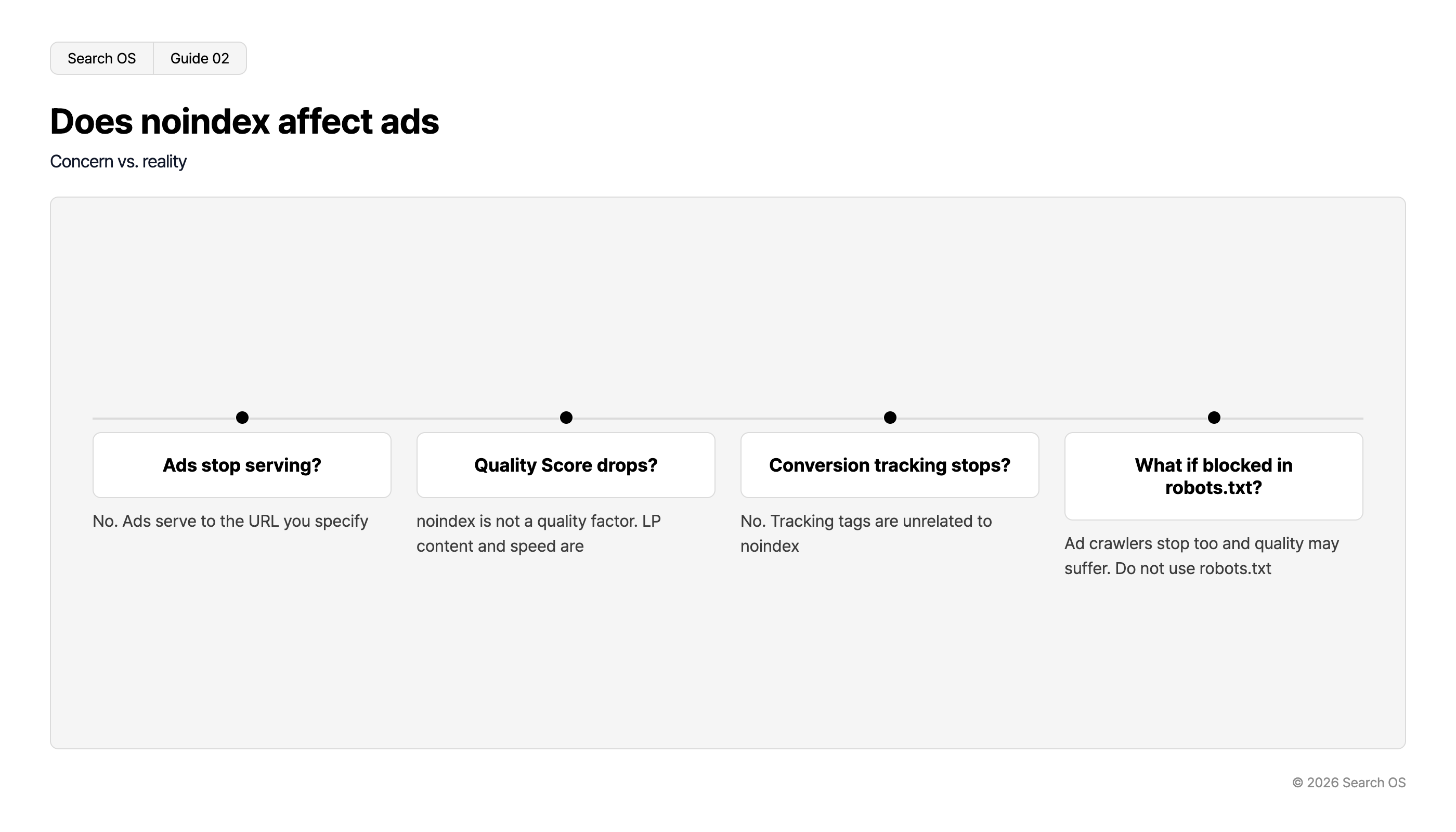
Does noindex affect ads
Concern vs. reality
| Concern | Reality |
|---|---|
| Ads stop serving? | No. Ads serve to the URL you specify |
| Quality Score drops? | noindex is not a quality factor. LP content and speed are |
| Conversion tracking stops? | No. Tracking tags are unrelated to noindex |
| What if blocked in robots.txt? | Ad crawlers stop too and quality may suffer. Do not use robots.txt |
© 2026 Search OS
noindex is safe. Blocking in robots.txt, however, can affect the ad side's crawler too, so don't use it on LPs. Stop indexing only; don't stop fetching. Check whether any LP is blocked in robots.txt.
Designing one LP to keep as the landing spot for search
If you noindex all 30 LPs, search traffic drops to zero. If you also want to appear in search, keep just one LP as the landing spot for search.
Separate from the ad LPs, build a page that covers how to choose, comparisons, and ingredients
Put its URL inside the main site's structure, not under /lp/
Separate its role from the main product page (product page = this product, landing spot = which one to choose)
Output Article structured data
LPs keep multiplying after the setup
Someone forgets to set noindex on a new LP. A campaign LP stays indexed after it ends. The main page a canonical points to has been deleted. These things happen routinely.
Search OS continuously checks the list of indexed URLs, the state of noindex and canonical settings, and which LPs bots actually fetch, for shops that mass-produce LPs, including on ecforce. Missed settings and LPs left behind after a campaign are organized as fixes to make. It does not replace building the LPs. It is the layer that keeps checking how the LPs you built look to search engines.
Frequently asked questions
If I noindex an LP that is already indexed, how long until it disappears?
It is excluded at the next crawl. Expect a few days to a few weeks. If it is urgent, hide it temporarily with the removals tool in Search Console.
Will the main product page rank higher if I noindex the LPs?
It can, since the signal that was spread out gathers on the main page. If the LPs had little signal to begin with, the change is small.
Do AI crawlers visit noindex LPs?
noindex is an indexing instruction, so it doesn't stop fetching. AI crawlers can still fetch an LP. If you don't want it cited, one option is to exclude only AI crawlers from the LPs in robots.txt. Write it so it doesn't affect the ad side's crawler.
Related reading
How AI Search Reads ecforce Subscription Terms and Cancellation Pages
Duplicate URLs from Shopify Collections and Tags and Crawl Efficiency
References
Google Search Central: Block Search indexing with noindex
Google Search Central: Consolidate duplicate URLs
Google Search Central: Robots.txt introduction