futureshop Multi-Group Duplicate URLs and canonical
Navigation
- Search OS
- futureshop
futureshop Multi-Group Duplicate URLs and canonical
| Category | Read Time | Description Tagline | Brand |
|---|---|---|---|
| Guides | 5 min read | Japan EC platform guides for search and AI search | Search OS |
When one product is registered in several futureshop groups, the same product can end up with multiple group-based URLs. This article explains how duplicate URLs split search performance and how to check whether it's happening in your shop. It also covers where canonical should point and the rules for group design.
- URL
- searchos.io/en/blog
- Copyright
- © 2026 Search OS
If you register one product in several futureshop groups, Search Console may register the same product as separate URLs and flag it as "Duplicate".
The short answer: don't leave it alone. When the same product exists at several URLs, the search engine decides on its own which one is the real one. Backlinks and performance then split across the URLs, and none of them earns a full assessment. AI search behaves the same way. When several pages carry the same content, they are less likely to be chosen as a citation source.
This article explains how duplicate URLs arise and how to check whether it's happening in your shop. It also covers how to decide where canonical points, and the rules for group design.
Conclusion: Point every product page's canonical to a URL that doesn't depend on the group
Situation | Action |
|---|---|
Product URL contains the group ID, so each group yields a different URL | Point canonical to the group-free product URL. Align internal links to that URL too |
One product URL, but group-list pagination is duplicated | Self-referencing canonical on each list page. Don't consolidate to page 1 |
canonical points to a group-based URL | Fix the target. Check every product |
No duplicates | Do nothing. Check "Duplicate" in Search Console once a month |
Navigation
- Search OS
- Guide 01
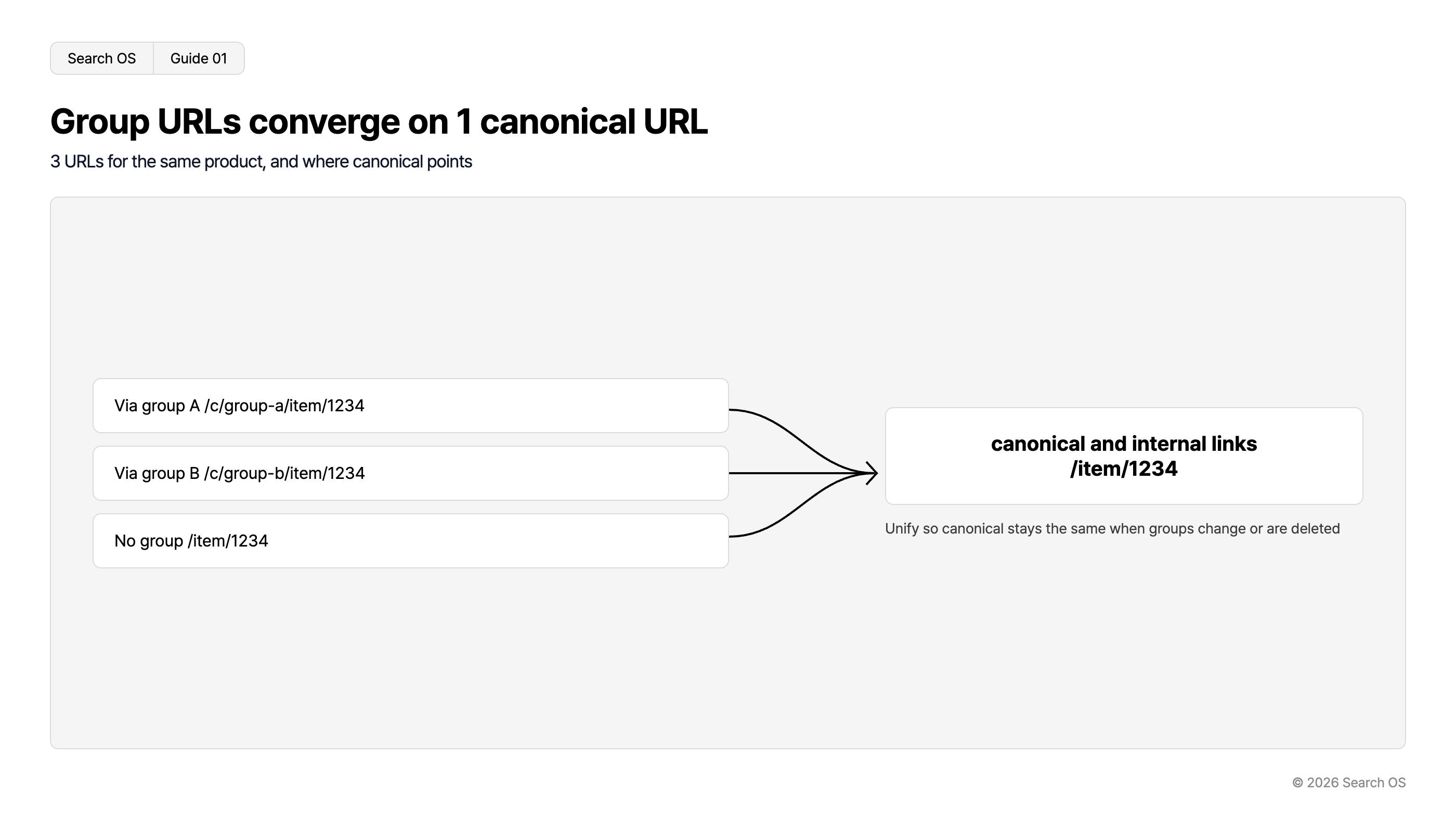
Group URLs converge on 1 canonical URL
3 URLs for the same product, and where canonical points
| Source URL Path | Target Canonical URL |
|---|---|
| Via group A /c/group-a/item/1234 | canonical and internal links /item/1234 |
| Via group B /c/group-b/item/1234 | canonical and internal links /item/1234 |
| No group /item/1234 | canonical and internal links /item/1234 |
Unify so canonical stays the same when groups change or are deleted
© 2026 Search OS
Key idea: canonical is a declaration: "this is the official URL of this page." If the declaration differs from product to product, the declaration itself isn't trusted. Decide on one form for product URLs, and align every canonical and internal link to that form.
How duplicates arise
futureshop lets you register a product in several groups. If the URL carries group information when a product is reached through the group hierarchy, the same product gets URLs like these.
Product URL via group A
Product URL via group B
Product URL with no group
To find out whether your shop's product URLs take this form, open the same product from different groups and compare the URLs. Open a mug from both "Kitchen" and "Gifts", for example. If the URL is the same, the duplication problem in this article isn't happening.
How to check whether it's happening in your shop
Open one product from each group it's registered in and compare the URLs.
In the Search Console Pages report, check for "Duplicate without user-selected canonical" and "Duplicate, Google chose different canonical than user".
In the product page source (HTML), search for
rel="canonical"and check where it points.
If step 3 shows a group-based URL as the target, it needs fixing. Run this check once on your main products first.
Where canonical should point
Candidate | Suitable as the target |
|---|---|
Product URL without a group | Best fit. Most stable; unchanged when groups change |
Product URL via the main group | Limited. Changing the group changes the canonical too |
URL of the group the product was first registered in | No. Can't be tracked in day-to-day operation |
Breadcrumbs
- Search OS
- Guide 02
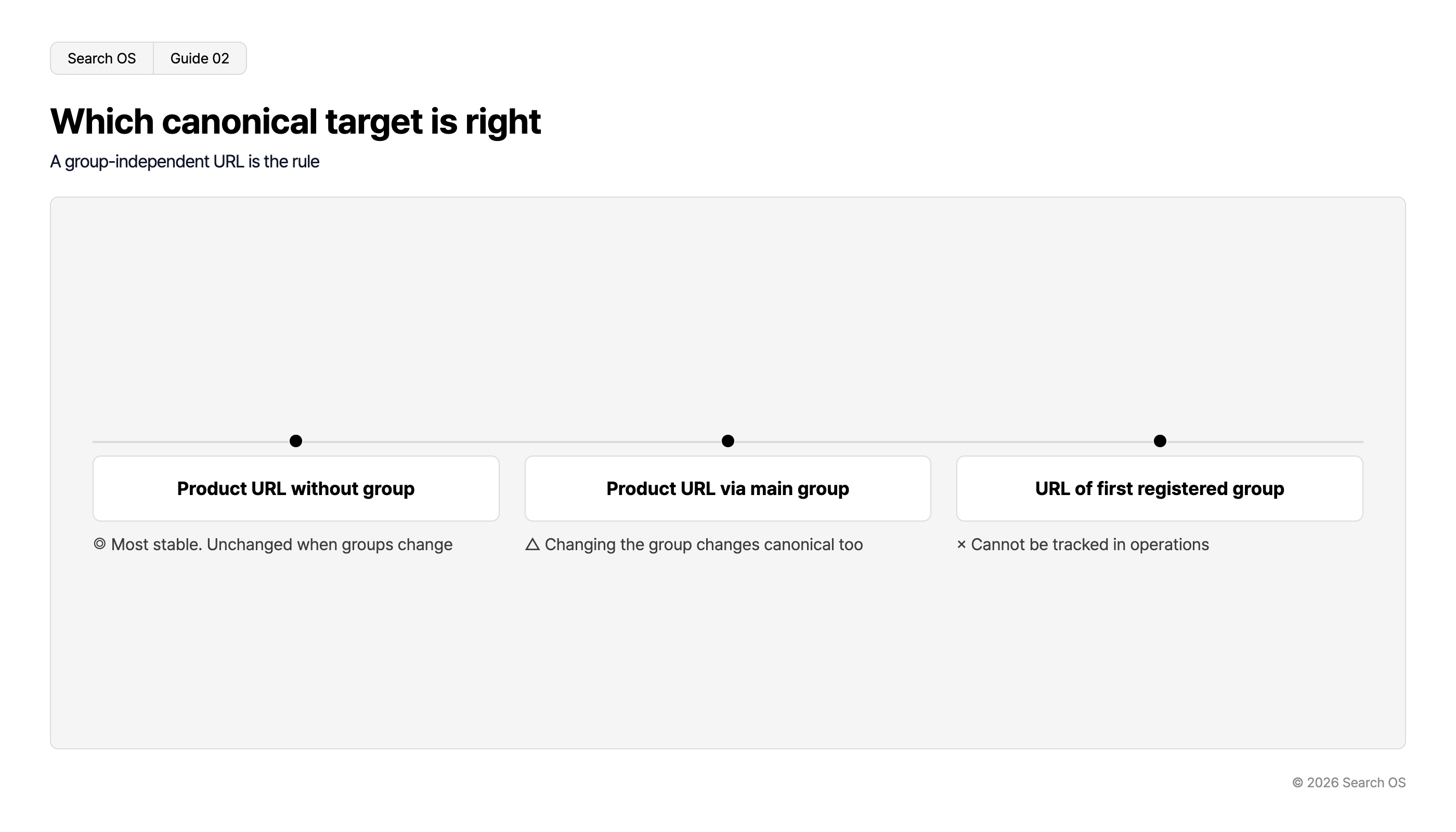
Which canonical target is right
A group-independent URL is the rule
| Target Type | Description |
|---|---|
| Product URL without group | ◎ Most stable. Unchanged when groups change |
| Product URL via main group | △ Changing the group changes canonical too |
| URL of first registered group | × Cannot be tracked in operations |
© 2026 Search OS
The rule is to unify on the URL without a group. If futureshop outputs canonical automatically, check the specification for its target and correct it in the template or settings if needed. The criterion is a URL that stays the same when the group changes.
Align internal links too
Even with canonical aligned, the effect weakens if internal links still use group-based URLs. This means links from group lists to products and related-product links. Search engines sometimes give more weight to the URL that is linked. Check that the URLs emitted by list parts and related-product parts take the same form as the canonical.
Rules for group design
Register products only in groups that are meaningful classifications. Temporary groups like "Sale" and "New arrivals" are not product classifications. Handle them with tags or feature pages.
Keep the group hierarchy to three levels. Deep hierarchies complicate URLs and internal links.
In group-list pagination, each page has a self-referencing canonical. Pointing page 2's canonical to page 1 is a mistake.
When deleting or merging groups, check where the URLs via that group redirect.
Keeping things aligned afterward
Every time you add a product or change a group, the alignment between canonical and internal links breaks down. Continually checking the canonical target on every product, and whether internal links use the same URL as the canonical, is not sustainable by hand.
Search OS supports existing shops, including futureshop. It continuously verifies the alignment of canonical, internal links, and metadata, and finds duplicate URLs and wrong canonical targets. Gaps between the URLs bots fetch and the canonical are compiled as fix candidates too. It doesn't change the URL design; it is a layer that keeps watching whether the design is holding.
Frequently asked questions
Do duplicate URLs lower rankings?
It isn't a penalty, but performance splits. If the assessment is divided across three URLs, it's weaker than when concentrated on one.
Can I remove duplicates with noindex?
noindex is an instruction not to index; it doesn't consolidate performance. Consolidation is done with canonical.
Will reducing the number of groups solve it?
If the structure of group-based URLs itself doesn't change, the remaining groups will still duplicate. Fixing the canonical target is the surer route.
Related reading
What Structured Data futureshop Outputs Automatically, and What to Add for AI Search
Duplicate URLs from Shopify Collections and Tags and Crawl Efficiency
References
Google Search Central: Consolidate duplicate URLs
Google Search Central: Pagination, incremental page loading, and Search
Google Search Central: Page Indexing report