SI-Built Sites: Adding SEO and AI Readiness Without Development Time
Navigation
- Search OS
- EC in general
SI-Built Sites: Adding SEO and AI Readiness Without Development Time
- Category
- Insights
- Reading Time
- 7 min read
- Topic
- Japan EC platform guides for search and AI search
When you add SEO and AI search readiness to an ecommerce site that a system integrator (SI) built, fixing the original code presupposes a development cycle and a change contract. Placing a separate rendering layer for search engines and AI crawlers, without changing the original, lets you proceed without taking new development time. This article compares the two approaches and lays out scope, limits, and decision criteria.
- Source
- searchos.io/en/blog
- Copyright
- © 2026 Search OS
This is among the most common questions from companies with an SI-built (system-integrator-built) ecommerce site. Fixing the template or the head requires a change estimate and a development cycle, so the work lands six months out. They ask whether there is a way to move SEO and AI search readiness forward without taking new development time.
The answer is yes, but it depends on the approach. Fixing the original code inevitably means waiting on the development cycle. Rendering is the process by which a browser assembles the screen. There's another approach: leave the original untouched and hand search engines and AI crawlers a separate rendering layer. That rendering layer is a screen reassembled for bots. This approach can proceed apart from the SI's development cycle.
This article first confirms why SEO changes stall on SI-built sites, then compares the two approaches, their scope and limits, the decision criteria, and a real case.
Conclusion: Fixing the original needs a development cycle. A separate rendering layer can proceed independently
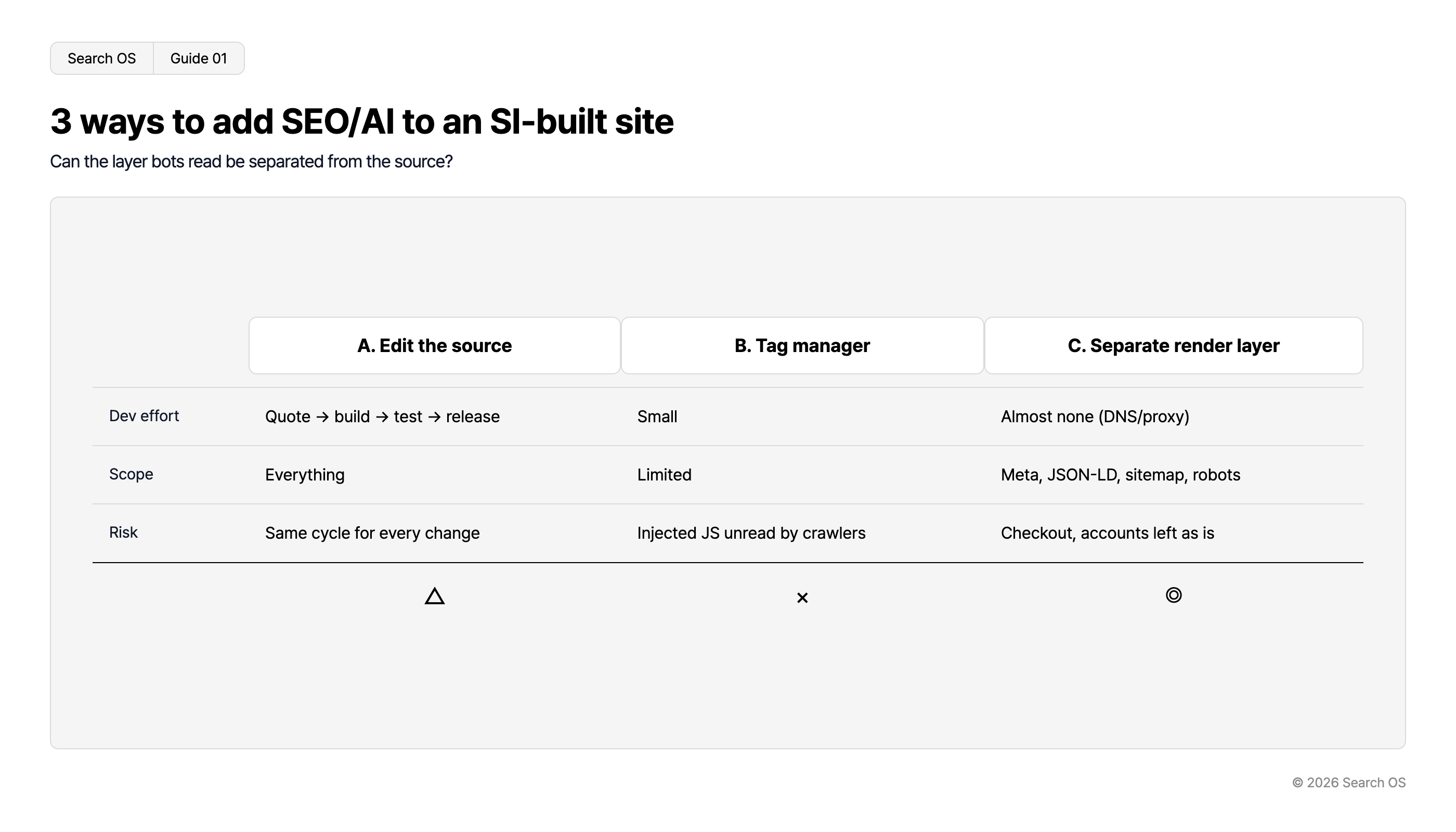
Approach | What it is | Development time | Scope | Risk |
|---|---|---|---|---|
A. Fix the original | Ask the SI to rework templates, head, and structured data | A full cycle of estimate, development, testing, and release | Everything | The same cycle for every change. Extra cost if outside the maintenance contract |
B. Via tag manager | Inject meta tags and structured data through GTM or similar | Small | Limited | JavaScript injection often isn't read by crawlers. Not a root fix |
C. Separate rendering layer | Leave the original as is; separately serve organized HTML, metadata, and structured data for search engines and AI crawlers | Almost none (DNS or proxy configuration) | Metadata, structured data, sitemap, robots, canonical, visible text | Human-facing functions such as checkout and membership are out of scope (unchanged) |
Navigation
- Search OS
- Guide 01
3 ways to add SEO/AI to an SI-built site
Can the layer bots read be separated from the source?
| 구분 | A. Edit the source | B. Tag manager | C. Separate render layer |
|---|---|---|---|
| Dev effort | Quote → build → test → release | Small | Almost none (DNS/proxy) |
| Scope | Everything | Limited | Meta, JSON-LD, sitemap, robots |
| Risk | Same cycle for every change | Injected JS unread by crawlers | Checkout, accounts left as is |
| Rating | △ | × | ◎ |
© 2026 Search OS
For most SI-built sites, C is the realistic choice. A is the way it should be, but as long as you're bound to the change cycle, SEO and AI search readiness always runs six months behind. B looks easy. Most crawlers, though, don't reliably read content inserted later by JavaScript, so it often falls short of the expected effect.
Key idea: SEO and AI search readiness isn't work that changes the screen people see. It's work that puts the layer bots read in order. It's close to leaving the shop's interior alone and rewriting only the sign out front. If the layer bots read can be separated from the original, it can be operated apart from the development cycle. Start by thinking of the human-facing screen and the bot-facing layer as two separate things.
Why SEO changes stall on SI-built sites
The reason isn't technical. It's organizational.
The SI holds the change rights. Changing even one line of a template or the head means queuing for request, estimate, and approval.
The maintenance contract covers only bug fixes. SEO improvement counts as a feature addition and becomes a separate contract.
The release cycle is fixed. Once a quarter, say. SEO is an accumulation of small fixes, so it doesn't match that pace.
Rendering depends on JavaScript. If the framework the SI chose renders on the client side, crawlers can't read the product information. Fixing that becomes a large rework.
The fourth is an especially heavy item. If you fix the original, the rework comes close to swapping out the framework. Start by writing down which of the above apply to you.
What a separate rendering layer can and can't do
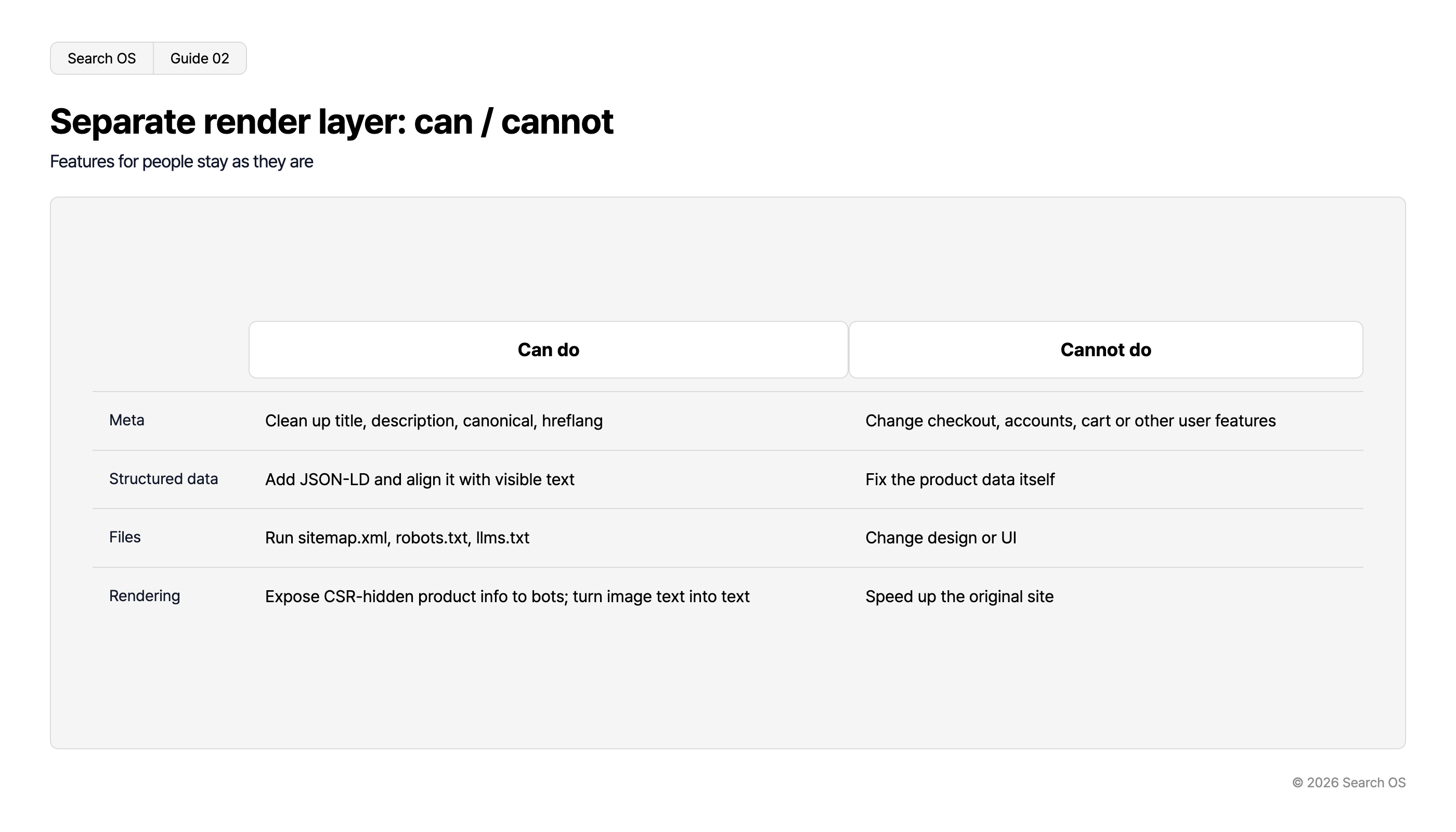
Can do | Can't do |
|---|---|
Organize title, meta description, canonical, and hreflang | Change human-facing functions such as checkout, membership, and cart |
Add JSON-LD (Product, Article, BreadcrumbList, and so on) and align it with visible text | Fix the product data itself (if the source data is wrong, the source must be fixed) |
Generate and operate sitemap.xml, robots.txt, and llms.txt | Change design or UI |
Expand product information hidden by client-side rendering into bot-facing HTML | Improve the original's performance (display speed for people) |
Convert text inside images into text | |
Collect and observe bot logs |
Navigation
- Search OS
- Guide 02
Separate render layer: can / cannot
Features for people stay as they are
| Category | Can do | Cannot do |
|---|---|---|
| Meta | Clean up title, description, canonical, hreflang | Change checkout, accounts, cart or other user features |
| Structured data | Add JSON-LD and align it with visible text | Fix the product data itself |
| Files | Run sitemap.xml, robots.txt, llms.txt | Change design or UI |
| Rendering | Expose CSR-hidden product info to bots; turn image text into text | Speed up the original site |
© 2026 Search OS
Anything touching the layer bots read is in scope; functions people operate are out. Turning product descriptions into text is in; changing the cart button is out. Most of the work SEO and AI search readiness needs falls into the former. Sort what you want to do into "for bots" and "for people".
Criteria for deciding whether it fits your company
A separate rendering layer suits you when two or more of the following apply.
A template change takes a month or more from request to release
SEO improvement is outside the scope of the maintenance contract
The site renders on the client side, and URL Inspection in Search Console shows no product information in the fetched HTML
There are thousands or more product, category, and content pages, so handling them one by one isn't realistic
Your company or your infrastructure vendor holds the rights to change CDN, WAF, and bot-protection settings
Confirm the last condition first. If you can't change DNS or reverse proxy settings, you can't insert a separate rendering layer. This is usually a conversation with the infrastructure team, not the SI. Find out who can change the DNS settings.
Case: with no additional developers or marketers
This is a Korean ecommerce brand with annual revenue of ₩40 billion (about ¥4 billion). Without asking the SI for changes, a separate rendering layer put the technical SEO foundation (rendering, canonical, metadata, structured data, indexability) in order in three weeks. Product descriptions that existed only in images were converted to HTML text with OCR. Hidden sold-out text left on products still on sale was removed. After that, product, category, and brand content were improved in priority order while watching bot logs. As a result, organic purchase revenue grew from about ₩92 million to about ₩166 million in three months. No additional developers or marketers were added. You can check whether your own product descriptions exist only as images with the same steps.
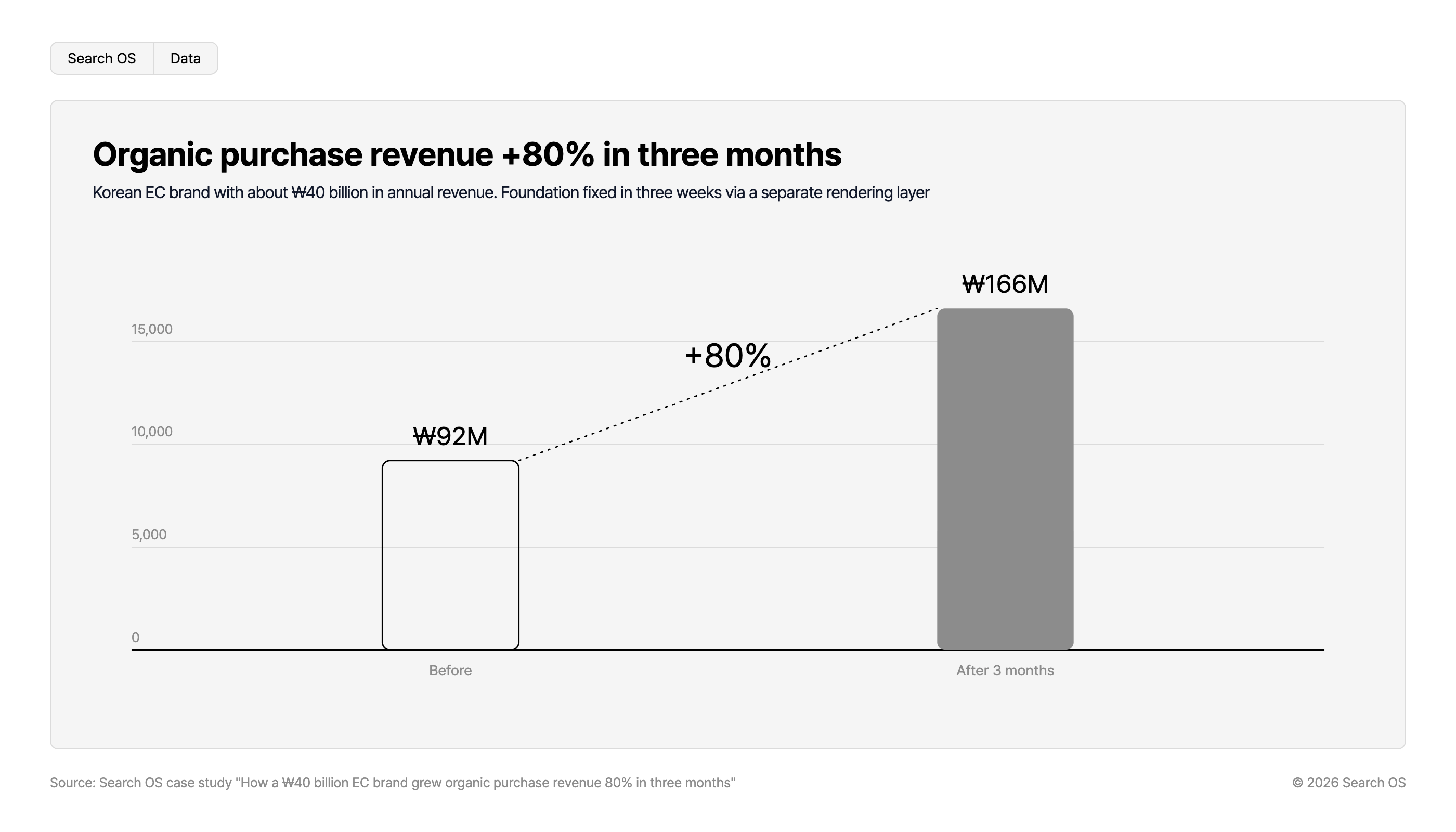
Organic purchase revenue +80% in three months
Korean EC brand with about ₩40 billion in annual revenue. Foundation fixed in three weeks via a separate rendering layer
| Period | Revenue | Growth |
|---|---|---|
| Before | ₩92M | |
| After 3 months | ₩166M | +80% |
Source: Search OS case study "How a ₩40 billion EC brand grew organic purchase revenue 80% in three months"
© 2026 Search OS
Toward operation independent of the development cycle
The biggest wall on an SI-built site isn't technology. It's a setup where every change waits on a development cycle. Separate the layer bots read from the original, and the marketing team can take the lead. Fixes and verification can run on a weekly cadence.
Search OS provides this separate rendering layer as an SEO/GEO automation solution. It doesn't disturb existing service operations much. It prepares a separate rendering structure that search engines and AI can read easily. It also puts metadata, semantic tags, sitemap.xml, robots.txt, canonical, and hreflang in order. Structured data and bot log observation are included and operated as one package. The SI's development cycle focuses on human-facing feature improvements, and Search OS handles the layer bots read. That's the division. Write down in advance which work goes to the SI and which goes to the separate layer.
Frequently asked questions
Can this be introduced without telling the SI?
Technically yes, since the original isn't changed. Changing DNS or proxy settings, though, requires coordination with the infrastructure team. Operation is more stable if you share the approach with the SI and separate roles from the plan for reworking the original.
Can it be combined with reworking the original?
Yes. Get results first with the separate rendering layer, and carry out the rework of the original in the next release cycle. That order is realistic. After the rework is done, the layer remains as a check that visible text and structured data match.
Where do I confirm the effect?
Use Search Console clicks, impressions, and index status as the baseline. In bot logs, check whether Googlebot, GPTBot, and others are actually fetching pages. Track citations in AI search through Bing Webmaster Tools' AI Performance and various AI visibility tools.
Related reading
SEO and GEO explained: AI search optimization for large platforms
Managing crawl budget and index gaps on a mall with tens of thousands of products
References
Google Search Central: JavaScript SEO basics
Google Search Central: Dynamic rendering as a workaround
Google Search Central: AI features and your website