ecforce: Winning Organic Search and AI Citations on an Ad-LP-Centered Site
Navigation
- Search OS
- ecforce
ecforce: Winning Organic Search and AI Citations on an Ad-LP-Centered Site
- Category
- Guides
- Reading Time
- 6 min read
- Topic
- Japan EC platform guides for search and AI search
Ad landing pages don't get cited by AI search. For a D2C brand running on ecforce to win organic search and AI citations, it needs pages that answer questions placed next to the LPs, with a structure that leads to the product. This article covers the six axes of questions, the division of roles between LPs and content, and how to increase mentions elsewhere on the web.
- Source URL
- searchos.io/en/blog
- Copyright
- © 2026 Search OS
D2C brands running on ecforce often have a setup where ad landing pages (LPs) carry almost all customer acquisition and organic search brings in almost nothing. The same brands ask why their company doesn't come up when they ask ChatGPT about their product category.
The short answer is that ad LPs aren't cited by AI search. An LP is a page that persuades. What AI search is looking for is a page that answers a question. That said, you don't need to abandon LPs. Place pages that answer questions next to the LPs, and build a structure that leads from them to the product and the LP.
This article lays out why LPs aren't cited, how to expand questions along six axes, the division of roles between LPs and content, and how to increase mentions elsewhere on the web.
Conclusion: LPs aren't cited. Place pages that answer questions next to them and lead to the product
Page | Role | How search engines and AI see it |
|---|---|---|
Ad LP | Persuade visitors from ads and lead them to purchase or subscribe | No answers to questions, and usually noindex. Not a citation candidate |
Product page | Show price, terms, and specifications | Has information, but isn't structured to answer questions |
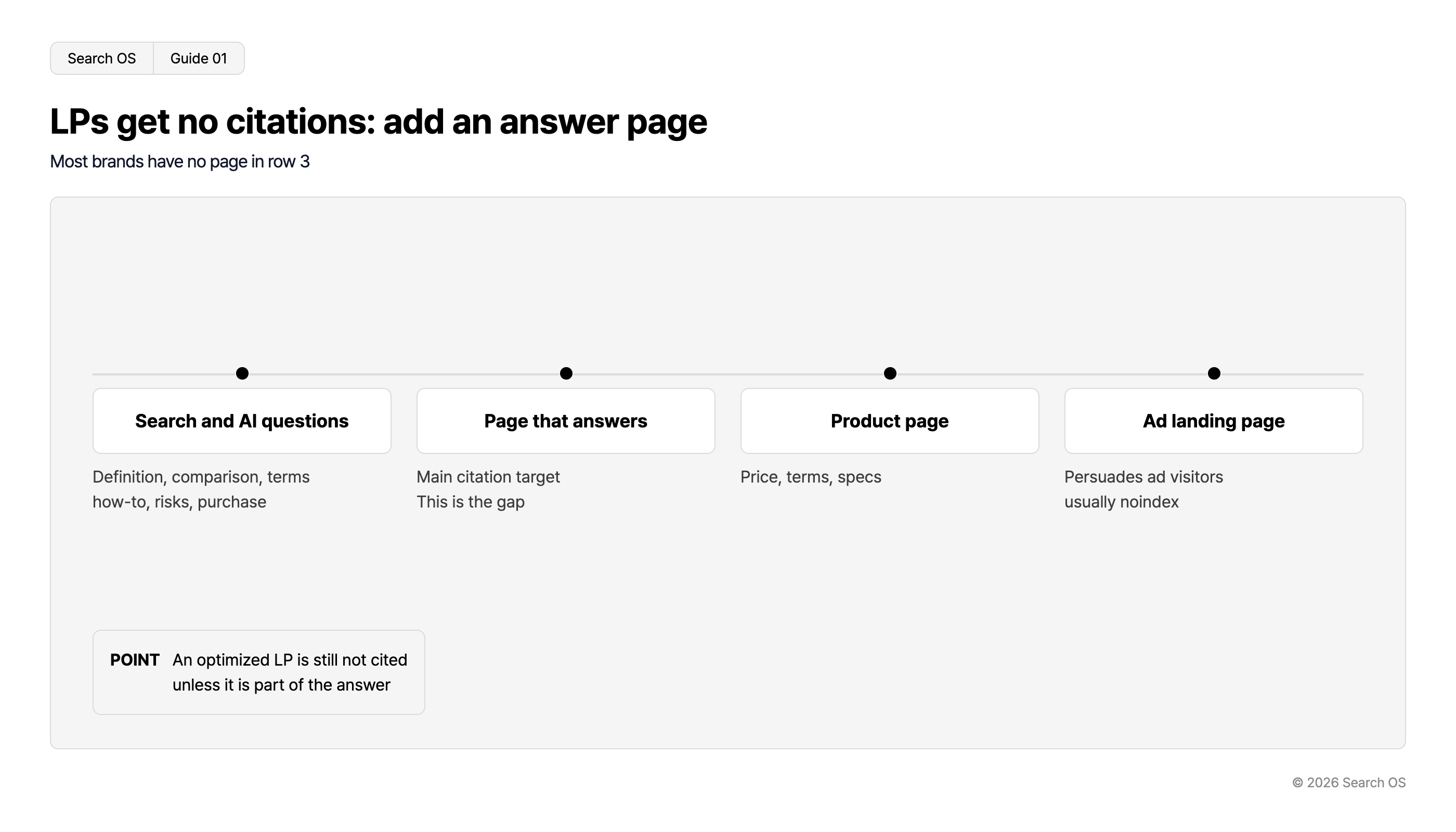
Question-answering page | Answers questions about definition, comparison, conditions, execution, risk, and purchase | The main citation target. This is what's missing |
Navigation
- Search OS
- Guide 01
LPs get no citations: add an answer page
Most brands have no page in row 3
| Stage | Description |
|---|---|
| Search and AI questions | Definition, comparison, terms how-to, risks, purchase |
| Page that answers | Main citation target This is the gap |
| Product page | Price, terms, specs |
| Ad landing page | Persuades ad visitors usually noindex |
- POINT
- An optimized LP is still not cited unless it is part of the answer
© 2026 Search OS
Most brands on ecforce have the first and second rows. What they lack is the third. Build the third row and link it to the second and the first. That is what works for both organic search and AI citations.
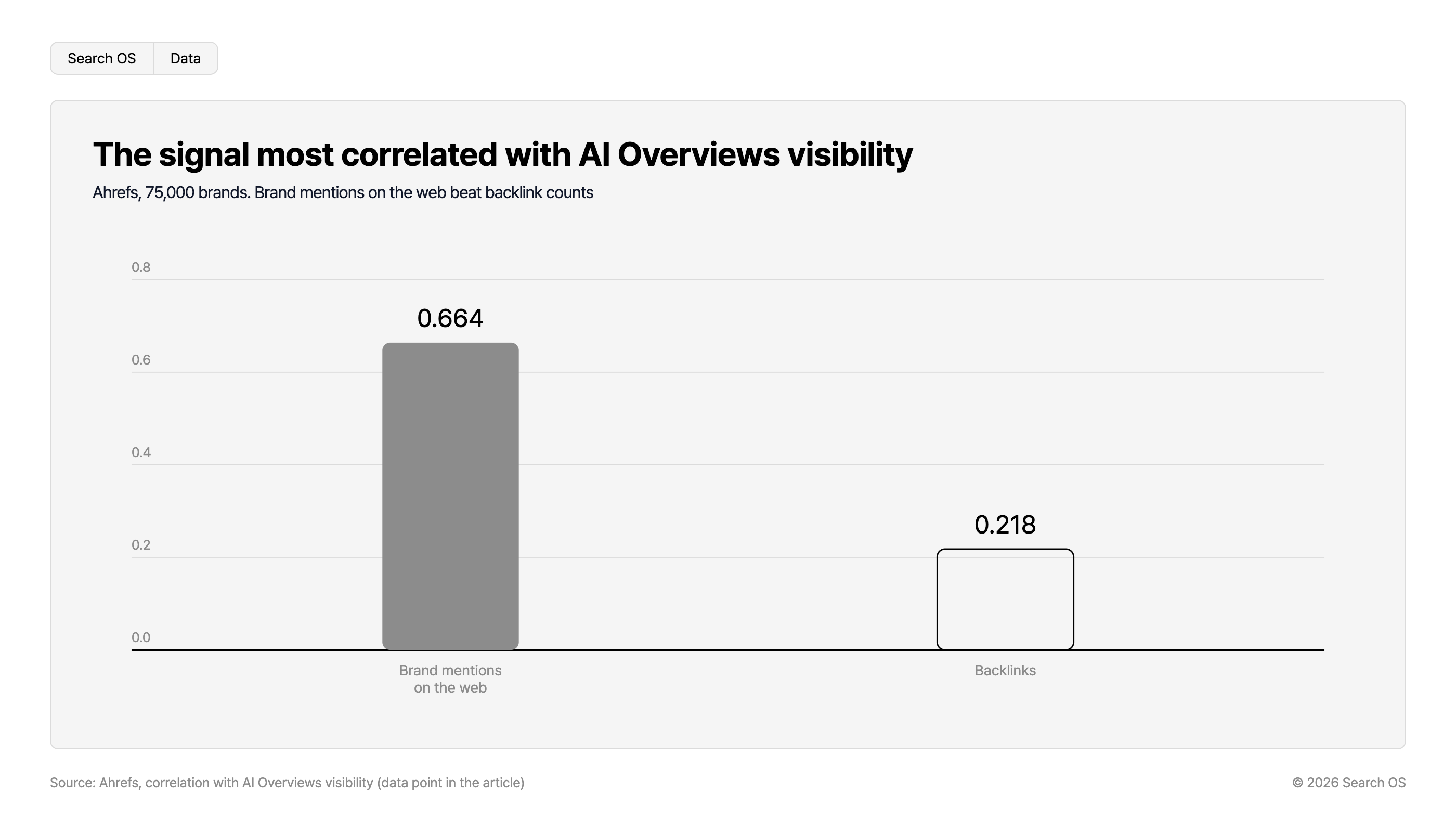
Data point: In an Ahrefs study analyzing 75,000 brands, the signal most strongly correlated with exposure in AI Overviews was not backlink count (0.218) but brand mentions across the web (0.664). However well you optimize an LP, AI won't cite it unless the brand is mentioned on the web as part of the answer.
Navigation
- Search OS
- Data
The signal most correlated with AI Overviews visibility
Ahrefs, 75,000 brands. Brand mentions on the web beat backlink counts
| Signal | Correlation Value |
|---|---|
| Brand mentions on the web | 0.664 |
| Backlinks | 0.218 |
Source: Ahrefs, correlation with AI Overviews visibility (data point in the article)
© 2026 Search OS
Three reasons ad LPs aren't cited
They don't answer questions. An LP explains why you should buy. When a user asks "how do I choose an X" or "what is the difference between A and B," the answer isn't on the LP.
They often aren't indexed. Ad LPs frequently carry noindex for ad quality management or to avoid duplication. They aren't even in the candidate pool for search engines and AI (check the settings on your own LPs).
They are built from images and long scrolls. Most of the pitch is text inside images. It isn't a structure machines can read.
Expanding questions along six axes
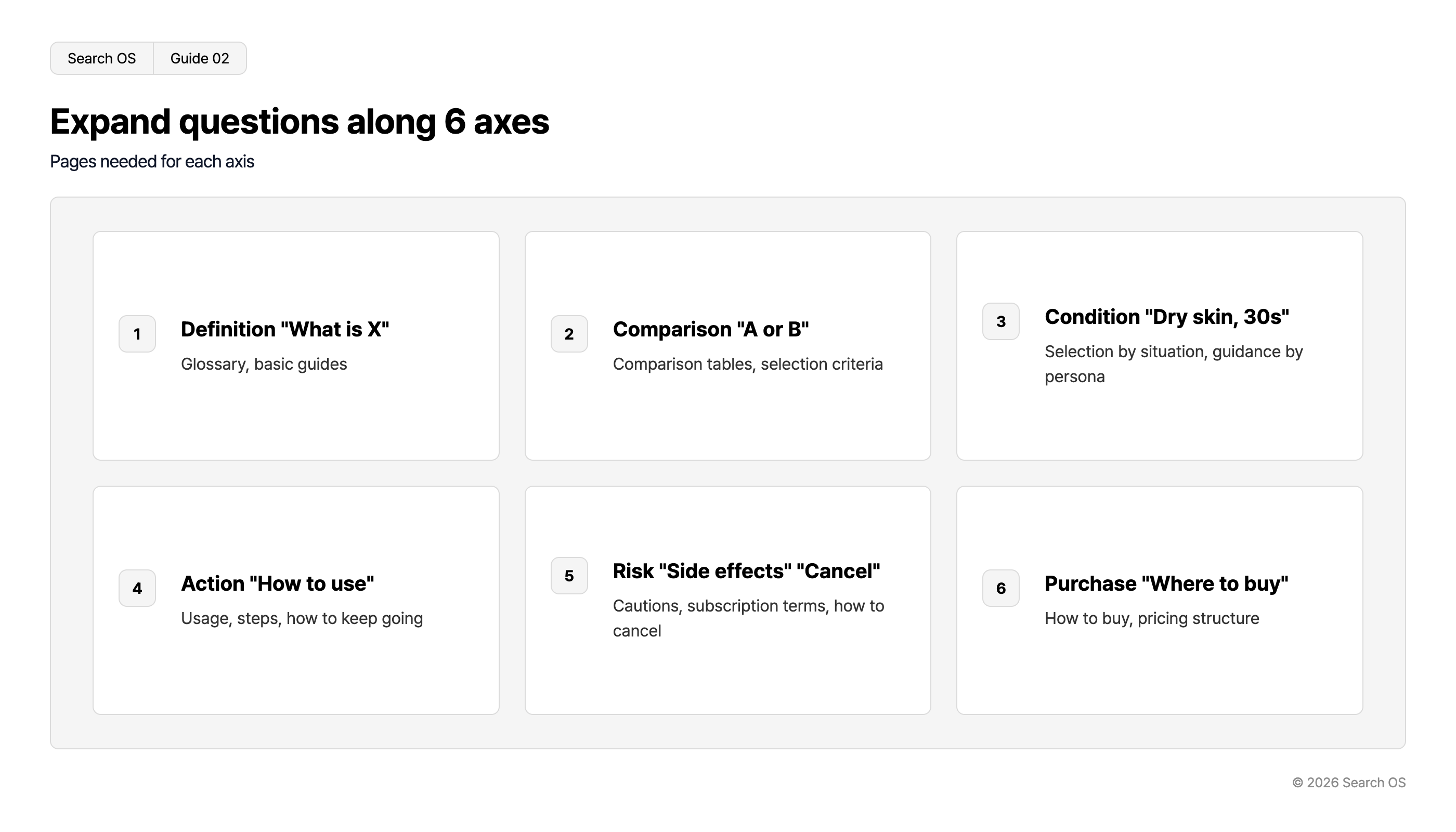
The questions users put to AI search are made of situations and conditions, not product names. Something like "a toner for dry skin." Pick one product category and write out questions along the following six axes.
Axis | How users ask | Page needed |
|---|---|---|
Definition | "What is X" "How does it differ from Y" | Glossary, basic guide |
Comparison | "Which is better, A or B" "What are the alternatives" | Comparison table, selection criteria |
Conditions | "For dry skin in your 30s" "If it's your first time" | Selection by situation, guidance by persona |
Execution | "How do I use it" "When should I start" | How to use, steps, how to keep going |
Risk | "Are there side effects" "What if it doesn't suit me" "How do I cancel" | Precautions, subscription terms, how to cancel |
Purchase | "Where do I buy it" "What's the difference between the subscription and the trial" | How to buy, explanation of pricing |
Navigation
- Search OS
- Guide 02
Expand questions along 6 axes
Pages needed for each axis
| index | axis_title | description |
|---|---|---|
| 1 | Definition "What is X" | Glossary, basic guides |
| 2 | Comparison "A or B" | Comparison tables, selection criteria |
| 3 | Condition "Dry skin, 30s" | Selection by situation, guidance by persona |
| 4 | Action "How to use" | Usage, steps, how to keep going |
| 5 | Risk "Side effects" "Cancel" | Cautions, subscription terms, how to cancel |
| 6 | Purchase "Where to buy" | How to buy, pricing structure |
© 2026 Search OS
For D2C brands, the risk and purchase axes matter most. Subscription terms and how to cancel are questions users always ask AI before buying. If the answer isn't on your site, the answer from a review site or comparison blog gets cited. Not answering in your own words is itself damaging to the brand image.
Division of roles between LPs and content
Item | Ad LP | Question-answering page |
|---|---|---|
Visitor | People who clicked an ad | People arriving via search or AI |
Goal | Sign-up | Understanding and trust, then guidance to the product and LP |
Structure | Image-centered, long scroll | Headings, tables, lists, short paragraphs |
Indexing | Usually noindex | index. Carries structured data (Article, BreadcrumbList) |
CTA | Sign-up button | Matched to the stage. Definition pages offer materials or a diagnostic; purchase pages offer sign-up |
Cross-links | From content to the LP | From content to the product and LP. From the LP to content is optional |
With roles separated, content can open the door from search and AI while the LP's conversion rate stays intact. Check the feature scope for how far you can build content pages on ecforce. If it falls short, consider linking with a brand site or a blog on a separate domain.
Why mentions elsewhere are needed
AI citation doesn't happen on your own site alone. Comparison articles, review sites, videos, and mentions on social media are the raw material. AI looks at those and judges that this brand is a trustworthy part of the answer.
Prepare an official comparison table so that comparison articles carry your accurate information (price, terms, features) and are easy to quote
State subscription terms and cancellation methods clearly on official pages to leave less room for misinformation from reviews to be cited
Put customer cases and reviews on your site as visible text
Running the shift from an LP-centered structure to an answer structure
Up to this point, you can do it by hand if you start with one product category. But as products multiply, questions multiply, and LPs get swapped out each season, hand work can't keep up. Which page answers which question. Which pages are cited, and which aren't even fetched. You end up tracking this continuously.
Search OS supports this operation. It doesn't change the ecforce LPs or product pages. It maps each group of questions to the page that should answer it, and provides the structure, metadata, and structured data that search engines and AI crawlers can read easily as a separate layer. It also checks bot logs for which pages GPTBot and PerplexityBot actually fetched. Missing questions and pages to fix are organized with priorities.
Frequently asked questions
Will ad LPs be cited if I set them to index?
Even when indexed, a page that doesn't answer a question isn't cited. Leaving the LP structure as it is and building separate question-answering pages is more effective.
Will creating content lower the ad conversion rate?
Not if the roles are separated. Put a path from content to the LP. Visitors arriving via search or AI gain more entry points to the persuasion stage.
What should I start with?
Start with one main product and build a page that answers the risk and purchase axes (subscription terms, how to cancel, difference from the trial) in official wording. This is the area most likely to be cited and where misinformation does the most damage.
Related reading
References
Google Search Central: AI features and your website
Google Blog: AI Mode in Search
ecforce: Official site