Product Descriptions AI Cites Within the PMD Act
Product Descriptions AI Cites Within the PMD Act
| Category | Read Time | Topic |
|---|---|---|
| Insights | 7 min read | Japan EC platform guides for search and AI search |
For cosmetics and health foods, the Pharmaceutical and Medical Device Act (PMD Act) limits the words a product description can use. In keeping within the limits, descriptions turn abstract and become hard for AI search to cite. This article covers how to build descriptions from facts about ingredients, usage, target users, and comparisons while respecting the restrictions, and how to give them the specificity AI can cite.
- Source
- searchos.io/en/blog
- Copyright
- © 2026 Search OS
Shops selling cosmetics and health foods on ecforce say that once they comply with the Pharmaceutical and Medical Device Act (PMD Act), they can write little more than "provides moisture," and every product description ends up the same. The same shops find that their products aren't cited when they ask AI.
What the PMD Act restricts is asserting effects. It doesn't restrict the specificity of facts. Ingredient names and the fact that they are included, the steps for use, the skin types and everyday situations the product is for. Differences from your other products, texture and scent, volume and how long it lasts. All of these can be written within the PMD Act, and all of them are material AI search cites. The reason you aren't cited isn't the legal restriction. It is that, in avoiding the restriction, you have cut the facts too.
This article lays out the kinds of facts you can write and the structure AI cites, how to draw the line on wording, and how to align descriptions across pages.
Conclusion: Don't talk about effects, talk about facts. The more specific the facts, the more they get cited
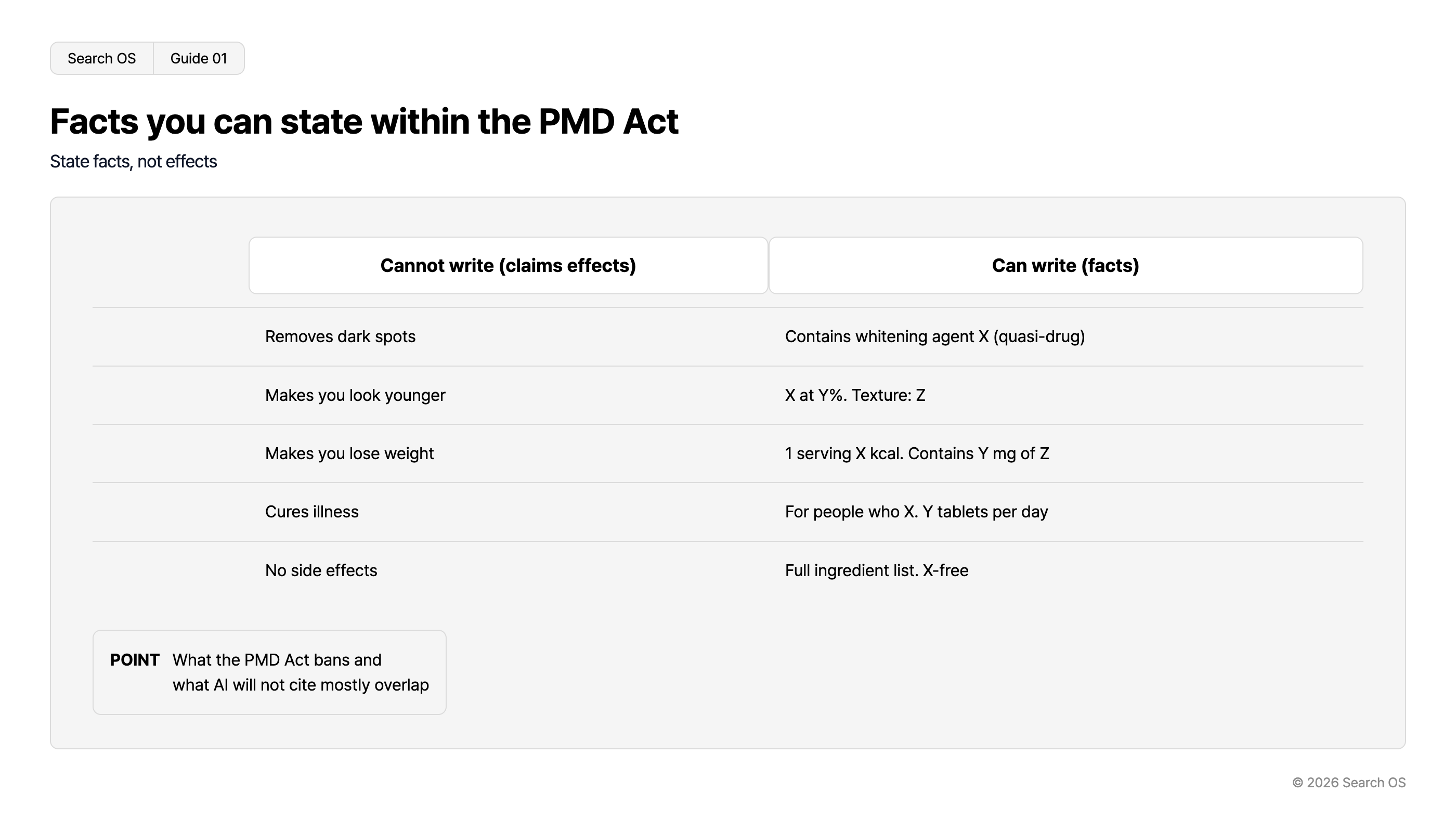
Can't write (asserting effects) | Can write (facts) |
|---|---|
Erases dark spots | Contains the whitening active ingredient X (for quasi-drugs). X is an ingredient approved as Y |
Makes you look younger | Contains N% X (ingredient). Texture is Z |
Makes you lose weight | N kcal per serving. Contains N mg of X (ingredient) |
Cures disease | For: people with an X lifestyle. Suggested use: N tablets per day |
No side effects | Full ingredient list. Free of X (as a fact) |
Facts you can state within the PMD Act
State facts, not effects
| Cannot write (claims effects) | Can write (facts) |
|---|---|
| Removes dark spots | Contains whitening agent X (quasi-drug) |
| Makes you look younger | X at Y%. Texture: Z |
| Makes you lose weight | 1 serving X kcal. Contains Y mg of Z |
| Cures illness | For people who X. Y tablets per day |
| No side effects | Full ingredient list. X-free |
- POINT
- What the PMD Act bans and what AI will not cite mostly overlap
Key idea: AI search doesn't cite the claim "it works." What it cites are facts: what, how much, and how. The expressions the PMD Act prohibits and the expressions AI doesn't cite overlap almost entirely. For a toner, "contains X, light and refreshing feel" is the one that gets cited, not "your skin is reborn." Replace the words about effects with words about facts, one at a time.
Facts you can write within the PMD Act
Type | Examples | Questions that get cited |
|---|---|---|
Ingredients and formulation | Names of main ingredients, their position in the full ingredient list, ingredients not used | "A toner with X" "Products that are Y-free" |
Usage | Steps, amount, timing, order when combined | "When do I use X" "Can I use it with Y" |
Target users | Skin type, age group, everyday situation, season | "An X for dry skin" |
Physical properties | Texture, scent, color, pH, viscosity | "A light, refreshing X" |
Specifications | Volume, how long it lasts at suggested use, container shape | "How many days does X last" |
Manufacturing | Country of manufacture, factory certifications, testing | "A made-in-Japan X" |
Comparison between your own products | Differences in ingredients, texture, and target users between A and B | "What's the difference between X and Y" |
None of these go beyond the PMD Act's scope of efficacy claims. Listing facts alone isn't enough, though. Assemble them into the form that answers when someone with dry skin asks "when do I use X." Check whether your product descriptions answer the questions in the "Questions that get cited" column.
The page structure AI cites
Position | Content |
|---|---|
Opening | What the product is, who it's for, and how to use it, in two or three sentences of fact |
Heading "Main ingredients" | Ingredient names and the facts of the formulation. In a table |
Heading "How to use" | Numbered steps |
Heading "Who it's for" | Facts about skin type and everyday situation. A description of the target user, not a promise of effect |
Heading "Difference from X" | Comparison table with your similar products |
Heading "Frequently asked questions" | Questions answerable with facts, such as combined use, storage, and shelf life |
Full ingredient list | As HTML text (not an image) |
Check the ecforce specifications for whether headings and tables can be used in the product description field. If they can't, put the details on a separate content page and link to it from the product page. It is like printing the ingredient table at the back of a recipe book. Start by reorganizing one main product into the order above.
Where the line falls, and what each category can say
Category | Cosmetics | Quasi-drugs | Health foods |
|---|---|---|---|
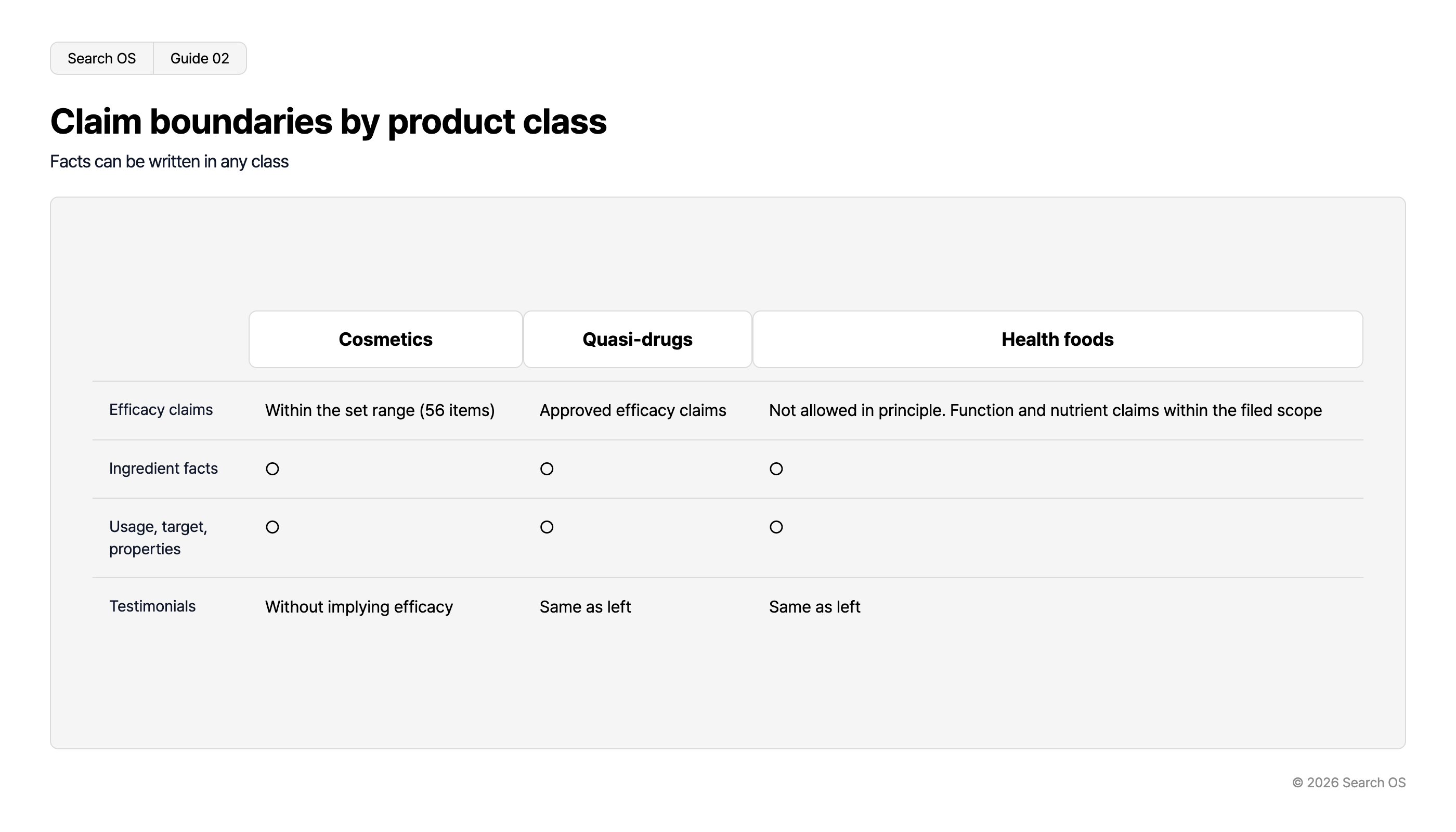
Efficacy claims | Within the defined scope (56 items) | Approved efficacy claims | Not allowed in principle. Foods with function claims and foods with nutrient function claims: within the notified or standard scope |
Facts about ingredients | Yes | Yes | Yes |
Usage, target users, physical properties | Yes | Yes | Yes |
Testimonials | Only where they don't suggest effects | Same as left | Same as left |
Navigation
- Search OS
- Guide 02
Claim boundaries by product class
Facts can be written in any class
| Category | Cosmetics | Quasi-drugs | Health foods |
|---|---|---|---|
| Efficacy claims | Within the set range (56 items) | Approved efficacy claims | Not allowed in principle. Function and nutrient claims within the filed scope |
| Ingredient facts | ○ | ○ | ○ |
| Usage, target, properties | ○ | ○ | ○ |
| Testimonials | Without implying efficacy | Same as left | Same as left |
© 2026 Search OS
Confirm the specific scope in the latest notices, and have a regulatory specialist review it if needed. This article doesn't replace a judgment on whether an expression is allowed. What supplements and cosmetics can say differs completely. Place your product's category, cosmetics, quasi-drug, or health food, against the table above and check.
The problem of descriptions drifting between pages
Product page, LP, ingredient page, FAQ. When the same ingredient is described with different names, formulations, or target users on different pages, AI detects it as a contradiction. Mixing "sodium hyaluronate" with "hyaluronic acid," or "for dry skin" with "for all skin types," is the kind of drift involved. To prevent it, manage the facts in one place and have every page reference that. Start by searching to confirm the main product's ingredient names are written the same way on every page.
You can't let go after writing
A product renewal, an ingredient change, an updated regulatory notice. Each time, you end up realigning the facts on every page. The more LPs a brand has, the easier it is for old ingredient listings and old target-user descriptions to linger. It is like last year's flyers still sitting at the back of the closet. Contradictory pages drop out of the sources.
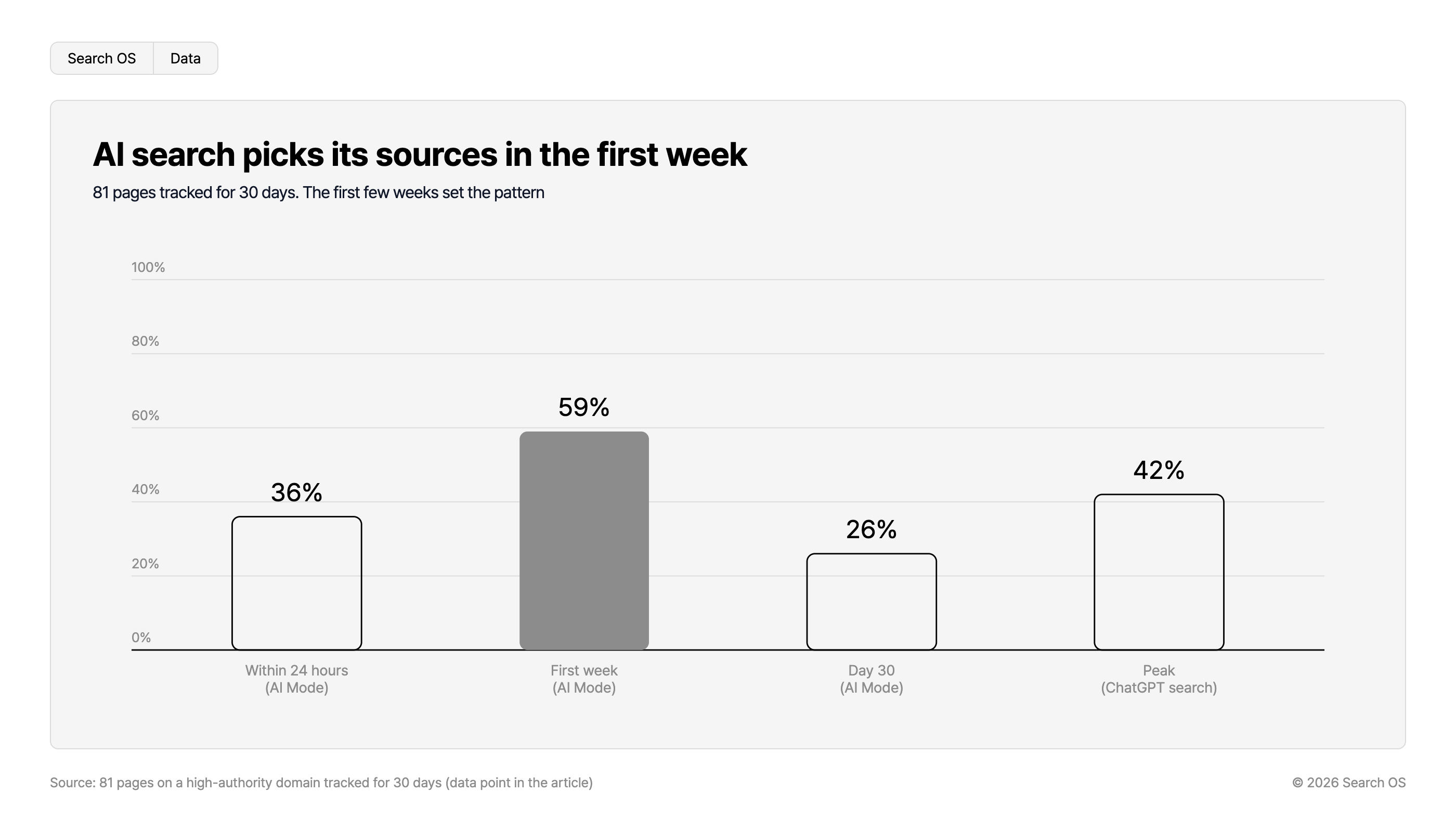
Data point: In an experiment tracking 81 pages on a high-authority domain for 30 days, ChatGPT search's citation coverage peaked at 42%. Google AI Mode fell from 59% in the first week to 26% by day 30. Even at equal quality, structure splits pages into those that get cited and those that don't.
AI search picks its sources in the first week
81 pages tracked for 30 days. The first few weeks set the pattern
| Timeframe / Mode | Percentage |
|---|---|
| Within 24 hours (AI Mode) | 36% |
| First week (AI Mode) | 59% |
| Day 30 (AI Mode) | 26% |
| Peak (ChatGPT search) | 42% |
Source: 81 pages on a high-authority domain tracked for 30 days (data point in the article)
© 2026 Search OS
Search OS supports cosmetics and health food shops, including on ecforce. It continuously checks that descriptions on product pages, LPs, and content pages match. It also checks that structured data is correct and which pages AI crawlers actually fetch. Contradictions and missed fetches are organized as fixes to make. It is not the layer that judges whether an expression is allowed. It is the layer that keeps watching that the expressions you settled on match on every page and are being read by AI.
Frequently asked questions
Won't sales drop if I only write facts?
Expressions that assert effects carry legal risk and also lower trust from AI and search engines. A product description with specific facts can answer pre-purchase questions, which makes it more likely to be chosen at the comparison stage.
Is it all right if reviews mention effects?
Reviews the business selects and publishes can be treated as the business's own expression. Avoid placing reviews that assert effects in prominent positions.
Can I put ingredients in Product structured data?
Product's standard properties have no field for ingredients. Convey them in the body text and tables.
Related reading
How AI Search Reads ecforce Subscription Terms and Cancellation Pages
What Keywords Alone Miss in AI Search: A Query Fan-Out Research Guide
References
Ministry of Health, Labour and Welfare: Standards for Fair Advertising Practices concerning Drugs and similar products
Consumer Affairs Agency: About foods with function claims
Google Search Central: Creating helpful, reliable, people-first content
Google Search Central: AI features and your website