AI Overviews
AI Overviews is a Google Search feature that places a generative-AI summary at the very top of the results page alongside links to the web pages it drew from. A custom Gemini model synthesizes multiple sources to answer the core of a query; it launched broadly in the U.S. in May 2024 and has since expanded worldwide.
- AI Overviews places an AI-generated summary plus supporting source links at the very top of Google's results, powered by a custom Gemini model, and rolled out broadly in the U.S. on May 14, 2024.
- Per Google's own documentation, there are no special requirements, dedicated schema, or AI-only files needed to appear in AI Overviews — standard SEO fundamentals apply unchanged.
- AI Overviews uses a query fan-out technique, running multiple sub-topic searches so it can surface a wider, more varied set of pages as sources than a typical search.
- A Pew Research analysis (July 2025) found that searches showing an AI summary had an 8% click-through rate to external links — roughly half the 15% rate for searches without one.
- You control exposure with robots.txt, nosnippet / data-nosnippet / max-snippet, and noindex; to limit AI training and grounding, use Google-Extended.
AI Overview
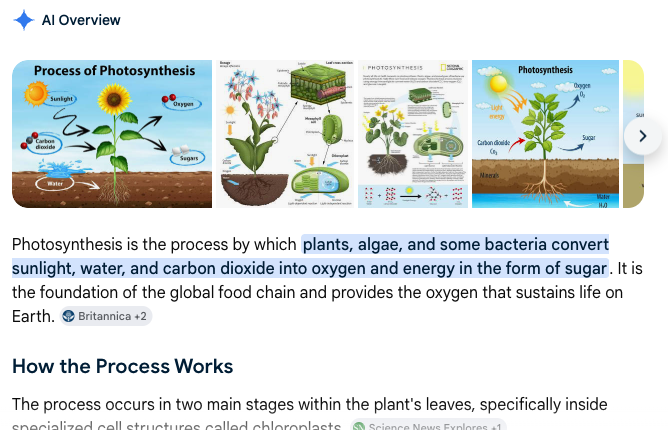
Photosynthesis is the process by which plants, algae, and some bacteria convert sunlight, water, and carbon dioxide into oxygen and energy in the form of sugar. It is the foundation of the global food chain and provides the oxygen that sustains life on Earth.
How the Process Works
The process occurs in two main stages within the plant's leaves, specifically inside specialized cell structures called chloroplasts.
Diagram 1: Process of Photosynthesis
- Sunlight
- Carbon dioxide
- Water
- Oxygen
- Sugars
Diagram 2: Leaf Cross-section and Chloroplast
- Leaf cross-section
- Mesophyll cell
- Chloroplast
- Light-dependent reactions
- Light-independent reactions
Diagram 4: Photosynthesis Overview
- Light energy
- Carbon dioxide CO2
- Minerals
- Oxygen O2
- Sugar
- Water H2O
What AI Overviews is
AI Overviews is a feature that, when a user enters a query on Google, displays a generative-AI summary answer at the very top of the results page together with links to the web pages that informed it. Because it gathers information from several sources into a single view, users can grasp the gist of a topic without opening multiple pages one by one, then click through to the links that let them dig deeper.
The feature is powered by a Gemini model custom-built for Google Search. After testing in Search Labs, Google announced on May 14, 2024 that it was rolling out AI Overviews to everyone in the U.S., and it has since expanded to more countries (source: Google "The Keyword" blog, Elizabeth Reid, 2024-05-14). In March 2025, Google said AI Overviews had grown into a feature used by "more than a billion people" and had been upgraded to Gemini 2.0.
How AI Overviews differs from traditional results
AI Overviews does not replace the classic "ten blue links." Google's systems add it on top of the results only when they determine it would be "genuinely helpful" beyond standard search, so it does not appear for every query.
| Aspect | Traditional results (SERP) | AI Overviews |
|---|---|---|
| Format | A ranked list of links | Generative-AI summary answer + source links |
| Placement | The body of the results page | The very top of the page (only when added) |
| Information handling | Per-page indexing and ranking | Synthesizes multiple searches via query fan-out |
| Trigger condition | Relevance and quality ranking | Fires only when "more helpful than standard search" |
| User behavior | Clicks through via links | Tends to get the answer in the summary, reducing clicks |
How AI Overviews works
Google's Search Central documentation explains that AI Overviews and AI Mode use a technique called query fan-out. A single question is expanded into multiple searches across related sub-topics and data sources, run in parallel, and the results are synthesized into one answer. Because the model uncovers more supporting pages in the process, a broader and more varied set of links can appear alongside the answer than in a typical web search.
How to appear in AI Overviews (the official guidance)
Google is unambiguous: "there's nothing special you need to do, and no additional requirements, to appear in AI Overviews or AI Mode." The crux of eligibility is simply that a page is indexed and eligible to appear in Google Search with a snippet. You do not need to create new machine-readable files, AI-only text files, or special schema.org structured data.
The fundamentals Google recommends are:
- Confirm that crawling is allowed in robots.txt and across your CDN and hosting infrastructure.
- Make content easy to discover through internal links.
- Provide a good page experience for users.
- Always make important content available as text.
- Ensure structured data matches the page's actual visible text.
- Focus on helpful, reliable, people-first content.
Controlling AI Overviews exposure
Because AI is integrated into Google Search, a site owner's primary lever for controlling AI Overviews exposure is robots.txt directives for Googlebot. To limit what a page exposes in search, use the controls below.
<!-- Block the snippet itself (and therefore the AI Overviews summary) -->
<meta name="robots" content="nosnippet">

<!-- Limit the number of characters used in the snippet -->
<meta name="robots" content="max-snippet:0">

<!-- Exclude only part of a page from the snippet -->
<p data-nosnippet>This sentence will not be used in a snippet.</p>

<!-- Opt out of some of Google's generative-AI training and grounding -->
User-agent: Google-Extended
Disallow: /
Note that nosnippet and max-snippet:0 also remove your ordinary search snippets, so apply them carefully with the potential traffic loss in mind. Google-Extended does not affect search visibility and only limits certain AI training and grounding.
The impact in real data
Pew Research Center's analysis of browsing data from 900 U.S. adults in March 2025 (published 2025-07-22) shows concretely how AI Overviews affects user behavior.
- 58% of respondents ran at least one Google search that included an AI summary in March 2025.
- On pages where an AI summary appeared, the rate of clicking a traditional search link was 8% — about half the rate on pages without a summary (15%).
- Clicks on a source link inside the AI summary accounted for just 1% of all visits.
- Users ended the search session outright on 26% of pages with an AI summary, higher than the 16% on pages without one.
- About 18% of the analyzed Google searches produced an AI summary, and 88% of those cited three or more sources. The median AI summary length was 67 words.
- Longer questions triggered AI summaries more often. Only 8% of one-to-two-word searches showed one, versus 53% of searches with ten or more words and 60% of questions beginning with a word like "who," "what," "when," or "why."
- The most-cited sources were Wikipedia, YouTube, and Reddit, and .gov (government) sites appeared in 6% of AI summaries — higher than their 2% share of standard results.
Google, for its part, states in its own analysis that "the clicks from search results with AI Overviews are higher quality" (users spend more time on the site), so interpretations of click volume versus click quality differ by source.
Practical checklist
- Confirm that core content is delivered as text and that Googlebot can crawl it (including robots.txt and your CDN).
- Place a clear, direct-answer paragraph for question-based and long-tail queries near the top of the page (AI summaries trigger more often on questions and long searches).
- Align structured data with the actual visible text, and strengthen trustworthy sourcing and expertise (E-E-A-T).
- Monitor traffic that includes AI features via the "Web" search type in the Search Console performance report.
- Apply nosnippet or noindex selectively only when you want to reduce summary exposure, weighing the loss of ordinary snippets as well.
References
- Google, "Generative AI in Search: Let Google do the searching for you" (The Keyword, 2024-05-14)
- Google, "Expanding AI Overviews and introducing AI Mode" (The Keyword, 2025-03)
- Google Search Central, "AI features and your website" (official documentation)
- Pew Research Center, "Google users are less likely to click on links when an AI summary appears in the results" (2025-07-22)