AI Citation
An AI citation is the source link or footnote that a generative search engine — such as ChatGPT, Perplexity, or Google's AI Overviews — displays to credit the web pages it drew on when generating an answer. The goal is no longer to rank as a blue link, but to be selected as a cited source inside the AI-generated answer itself, which makes citations the ultimate success metric that GEO and AEO aim for.
- An AI citation is the source link or footnote a generative engine shows for the web pages behind its answer; the objective is to appear inside the AI answer itself, not to win a ranked list.
- Because generative engines synthesize and summarize across multiple sources, getting cited depends on being chosen as a trustworthy basis for the answer — not on ranking #1.
- Citation behavior differs by engine: Perplexity searches the live web and surfaces inline footnotes aggressively, ChatGPT cites when search or tools are enabled, and Google's AI Overviews and AI Mode attach supporting links alongside the answer.
- Per Google's own documentation, a page can surface as a supporting link in AI Overviews and AI Mode if it is indexed and eligible to appear with a snippet — no special schema is required.
- The GEO paper (arXiv:2311.09735) showed that optimizations such as adding citations, statistics, and quotations from sources can lift visibility inside generative engines by up to 40%.
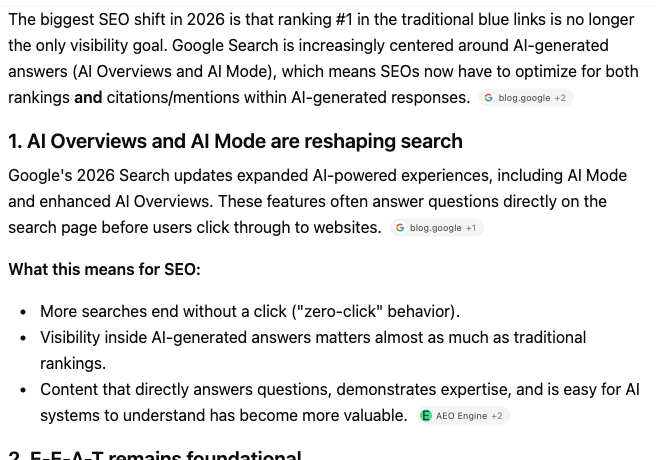
The biggest SEO shift in 2026 is that ranking #1 in the traditional blue links is no longer the only visibility goal. Google Search is increasingly centered around AI-generated answers (AI Overviews and AI Mode), which means SEOs now have to optimize for both rankings and citations/mentions within AI-generated responses. blog.google +2
1. AI Overviews and AI Mode are reshaping search
Google's 2026 Search updates expanded AI-powered experiences, including AI Mode and enhanced AI Overviews. These features often answer questions directly on the search page before users click through to websites. blog.google +1
What this means for SEO:
- More searches end without a click ("zero-click" behavior).
- Visibility inside AI-generated answers matters almost as much as traditional rankings.
- Content that directly answers questions, demonstrates expertise, and is easy for AI systems to understand has become more valuable. AEO Engine +2
2. E-E-A-T remains foundational
What an AI citation is
An AI citation is what a generative search engine displays — a source link, a footnote, or a "learn more" card — to credit the web pages that informed the answer it generated for a user's question. Traditional search returned ten blue links in ranked order, but a generative engine synthesizes and summarizes information from several sources into a single answer and then exposes only the underlying sources as citations. The content creator's objective therefore shifts away from "rank #1" and toward "be selected as a source inside the answer the engine produces."
The starting point for this shift was framed by researchers at Princeton and Georgia Tech in the GEO paper (Aggarwal, Murahari et al., arXiv:2311.09735, accepted to KDD 2024). The paper defines the essence of a generative engine as an LLM that answers by "synthesizing and summarizing information from multiple sources," and notes that creators have almost no control over "when and how" their content is shown. The AI citation becomes the core unit for measuring and managing exactly this uncontrollable exposure.
Why it matters
The AI citation is the success metric that reveals what optimization strategies like GEO and AEO ultimately exist for. In an answer-engine environment where users read the answer and end their search, a page that fails to appear as a citation inside that answer is effectively invisible. When a page is cited, by contrast, (1) the brand is exposed as an authoritative source, (2) some click traffic flows in, and (3) the page is repeatedly included in the pool of trusted candidates that the AI learns from and references.
In its official documentation, Google explains that AI Overviews and AI Mode "show relevant links so people can find information quickly and reliably." Google also states that both features use a query fan-out technique — issuing multiple searches at once across subtopics — to surface "a wider and more diverse set of supporting links than traditional web search." In other words, citation slots are not reserved for positions 1 through 3; the opportunity is distributed across far more pages.
How citation works by engine
Citation varies significantly with an engine's architecture. An analysis from Search Engine Land (Greg Jarboe) distinguishes between "model-native synthesis," where the engine answers from the model's own knowledge, and "RAG (retrieval-augmented generation)," where it retrieves documents in real time and attaches them as evidence. The more an engine leans toward the latter, the more readily it surfaces citations.
| Engine | Default behavior | How citations appear |
|---|---|---|
| Perplexity | Searches the live web, then synthesizes (question → search → synthesize → cite) | Surfaces sources aggressively as inline footnotes. Editors can verify each claim on the spot |
| ChatGPT | By default generates from the model's internal knowledge; behaves like RAG when search or tools are enabled | Shows sources/citations only when search or plugins are on. The default response has no sources |
| Google AI Overviews · AI Mode | Synthesizes across many pages via the search index plus query fan-out | Shows supporting links beside and below the answer. A page is a candidate once it meets index + snippet eligibility |
Some engines display sources abundantly, while others surface citations only when the user turns on a search feature. To get a single page cited across every engine, it is important to combine the freshness that live search can pick up with a clear, indexable structure.
Evidence and examples
- Optimization impact: The GEO paper (arXiv:2311.09735) ran experiments on GEO-bench, a benchmark of questions across diverse domains, and reported that optimizations adding source citations, statistics, and quotations can raise a page's visibility inside generative engines by up to 40%, with the effect varying by domain.
- Concentration and volatility of citation sources: A three-month study from Semrush (Luke Harsel, November 2025) analyzed three models — ChatGPT, Google AI Mode, and Perplexity — across 13 weeks, covering roughly 230,000 prompts and more than 100 million citations. Reddit and LinkedIn ranked among the top five cited domains on all three platforms, and citation share swung sharply even over short periods: ChatGPT's share of Reddit citations dropped from about 60% in early August to about 10% by mid-September.
- Limits on stability: The same study documents cases where a given domain disappeared from citations within a month, or doubled. An AI citation can shift due to changes in algorithms or source policies even after you secure it, so it is a metric that must be tracked and managed continuously rather than treated as a one-time win.
How to grow and manage citations
- Place a clear, direct answer sentence to the core question near the top of the page, so the answer engine can excerpt and cite it as-is.
- Back up claims with statistics, sources, and quotations — the leading signals for raising citation likelihood, as validated by the GEO paper.
- Make sure the page is indexed and eligible to appear with a snippet. Per Google, this is the minimum condition for a supporting link in AI Overviews and AI Mode, and no special schema is required.
- Regularly monitor how often your brand is cited or mentioned across AI answers to track changes in AI visibility and Share of Model.
- For areas where you do not want citations, use
nosnippet,data-nosnippet,max-snippet, ornoindex; to block use of your content for AI training and grounding, control it withGoogle-Extended.
References
- GEO: Generative Engine Optimization (Aggarwal, Murahari et al., arXiv:2311.09735, KDD 2024)
- Google Search Central — AI features and your website (AI Overviews · AI Mode)
- Search Engine Land — How different AI engines generate and cite answers (Greg Jarboe)
- Semrush — The Most-Cited Domains in AI: A 3-Month Study (Luke Harsel)