ecforce: How AI Reads Your Subscription Terms Page
Navigation
- Search OS
- ecforce
ecforce: How AI Reads Your Subscription Terms Page
- Category
- Insights
- Reading Time
- 6 min read
- Topic
- Japan EC platform guides for search and AI search
When you sell subscriptions on ecforce, the biggest pre-purchase questions are whether you can cancel, how many deliveries are required, and by when you have to give notice. AI search answers them by citing either the brand's page or a review site. This article covers the structure, placement, wording, and legal alignment needed to make your own subscription terms page the source that gets cited.
- Source
- searchos.io/en/blog
- Copyright
- © 2026 Search OS
Ask AI "can I cancel" about a subscription, and it cites a review site post saying "hard to cancel." Brands using ecforce raise this often: their own page states the correct terms, and yet this happens.
The reason it isn't cited is not what the page says. It is how and where it is written. For the question "can I cancel," AI search looks for a page where question and answer correspond one to one. The terms are buried in the long text of the terms of service. They only appear inside a step of the checkout form. They are written in an image. In that state, AI doesn't recognize the page as one where the answer is written. As a result, the review site that answers the question directly gets cited.
This article lays out the structure, placement, wording, and legal alignment needed to make your subscription terms page the source AI cites.
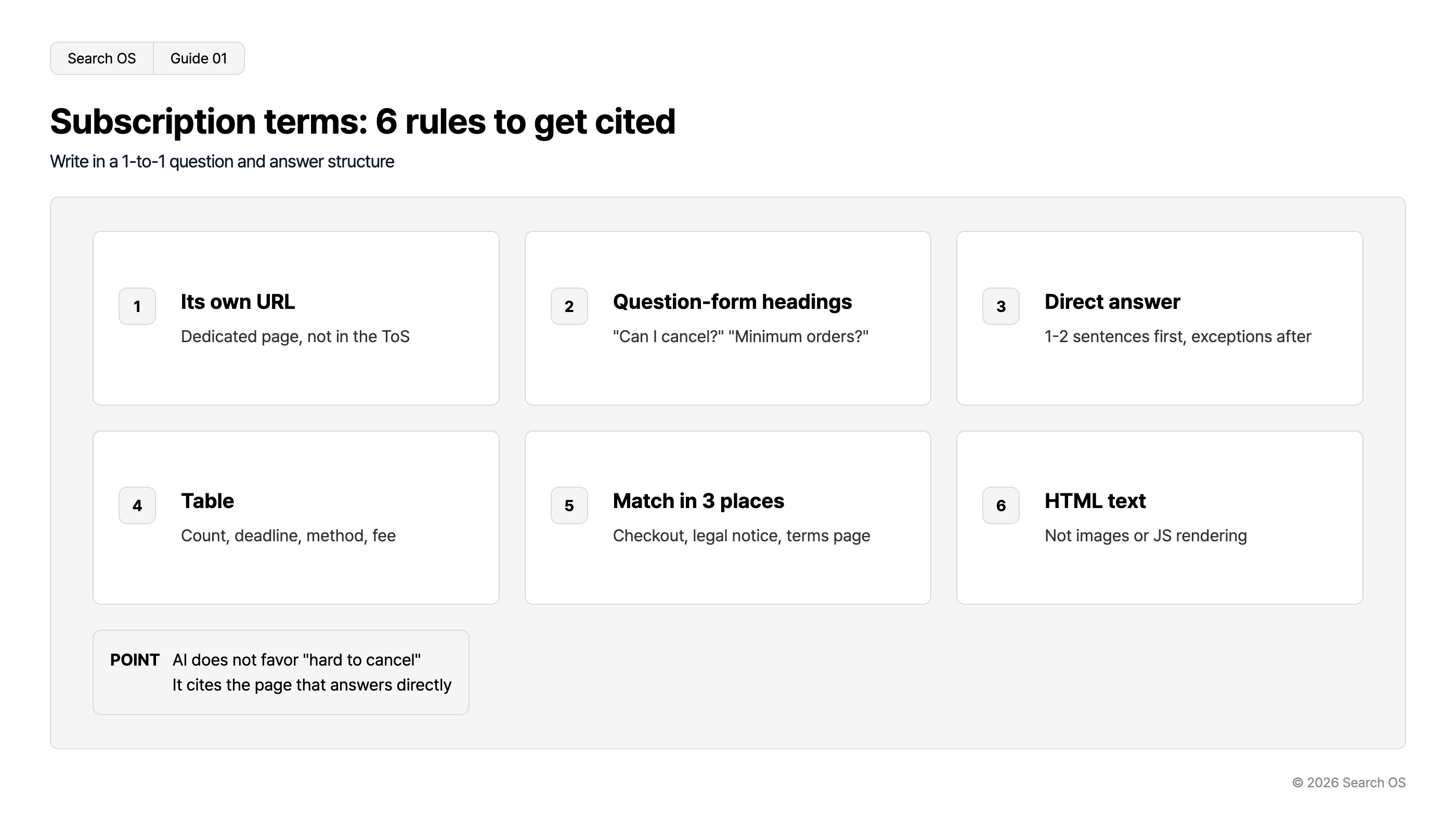
Conclusion: Make "subscription terms" a standalone page and write it as one-to-one question and answer
Requirement | Content |
|---|---|
Standalone URL | A dedicated page such as /subscription-terms, not part of the terms of service |
Question-form headings | Headings like "Can I cancel" and "What is the minimum number of deliveries" |
Direct answer | Directly under each heading, the terms in one or two sentences. Exceptions come after |
Table | Count, deadline, method, and fees in a table |
Consistency | The checkout form, the Specified Commercial Transactions Act page, and this dedicated page say the same thing |
Text | HTML text, not images. Not rendered afterward by JavaScript |
- Search OS
- Guide 01
Subscription terms: 6 rules to get cited
Write in a 1-to-1 question and answer structure
| number | title | description |
|---|---|---|
| 1 | Its own URL | Dedicated page, not in the ToS |
| 2 | Question-form headings | "Can I cancel?" "Minimum orders?" |
| 3 | Direct answer | 1-2 sentences first, exceptions after |
| 4 | Table | Count, deadline, method, fee |
| 5 | Match in 3 places | Checkout, legal notice, terms page |
| 6 | HTML text | Not images or JS rendering |
- POINT
- AI does not favor "hard to cancel" It cites the page that answers directly
© 2026 Search OS
Key idea: AI search isn't choosing the negative answer "hard to cancel" out of preference. It is simply citing the page that answers the question directly. If your site answers in the same format, more accurately, the citation moves to you. Check whether your terms are in a form that answers in a single sentence.
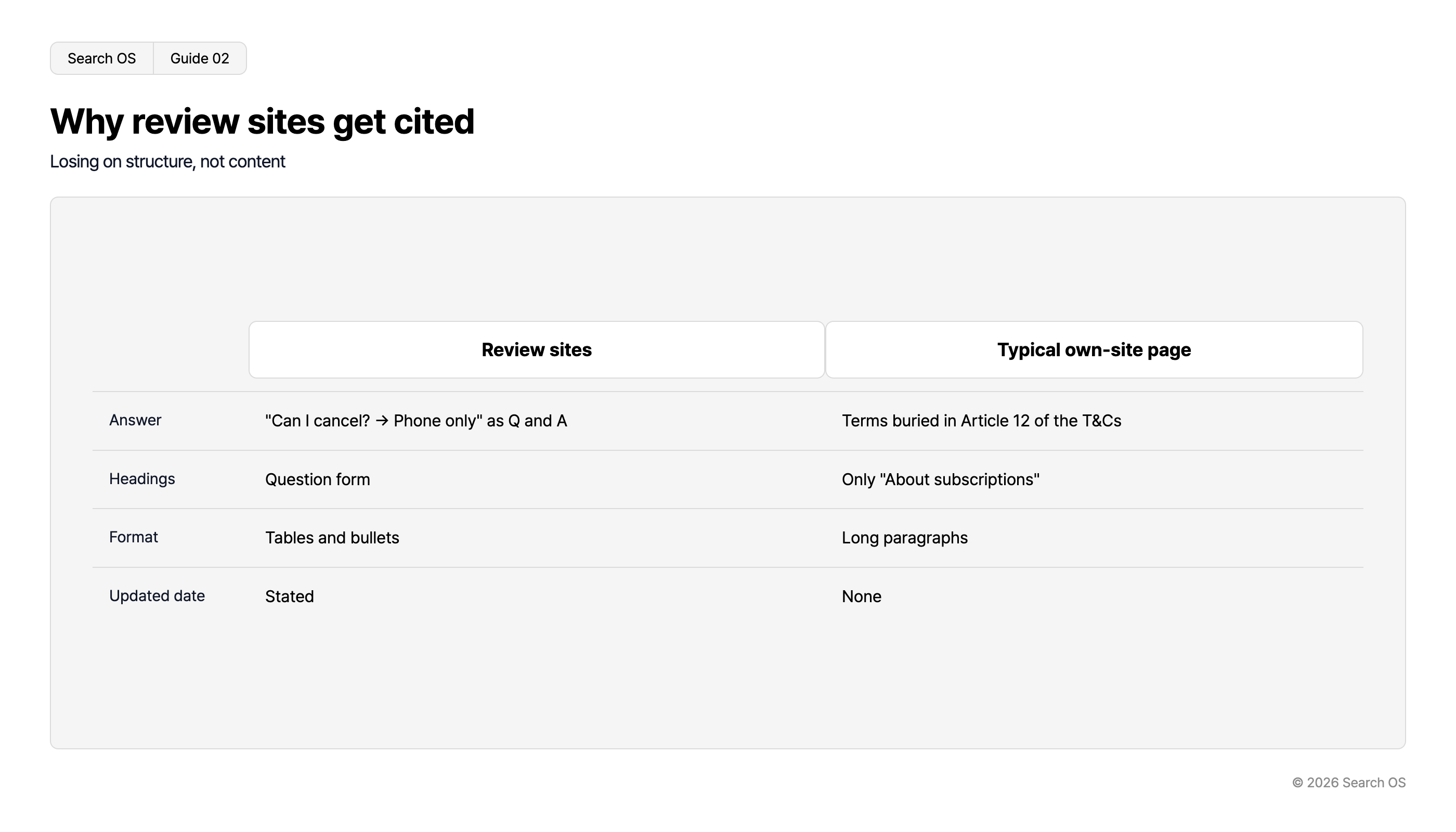
Why review sites get cited
Review site | Typical brand page |
|---|---|
Question and answer side by side: "Can I cancel? → Phone only, business hours" | The terms are written inside Article 12 of the terms of service |
Headings in question form | The only heading is "About subscriptions" |
Tables and bullet lists | Long paragraphs |
Update date shown | No update date |
Navigation
- Search OS
- Guide 02
Why review sites get cited
Losing on structure, not content
| Feature | Review sites | Typical own-site page |
|---|---|---|
| Answer | "Can I cancel? → Phone only" as Q and A | Terms buried in Article 12 of the T&Cs |
| Headings | Question form | Only "About subscriptions" |
| Format | Tables and bullets | Long paragraphs |
| Updated date | Stated | None |
© 2026 Search OS
From AI's point of view, the review site is the page that answers structurally. Before accuracy of content even comes into it, you are losing on structure. Count how many items in the right column apply to you.
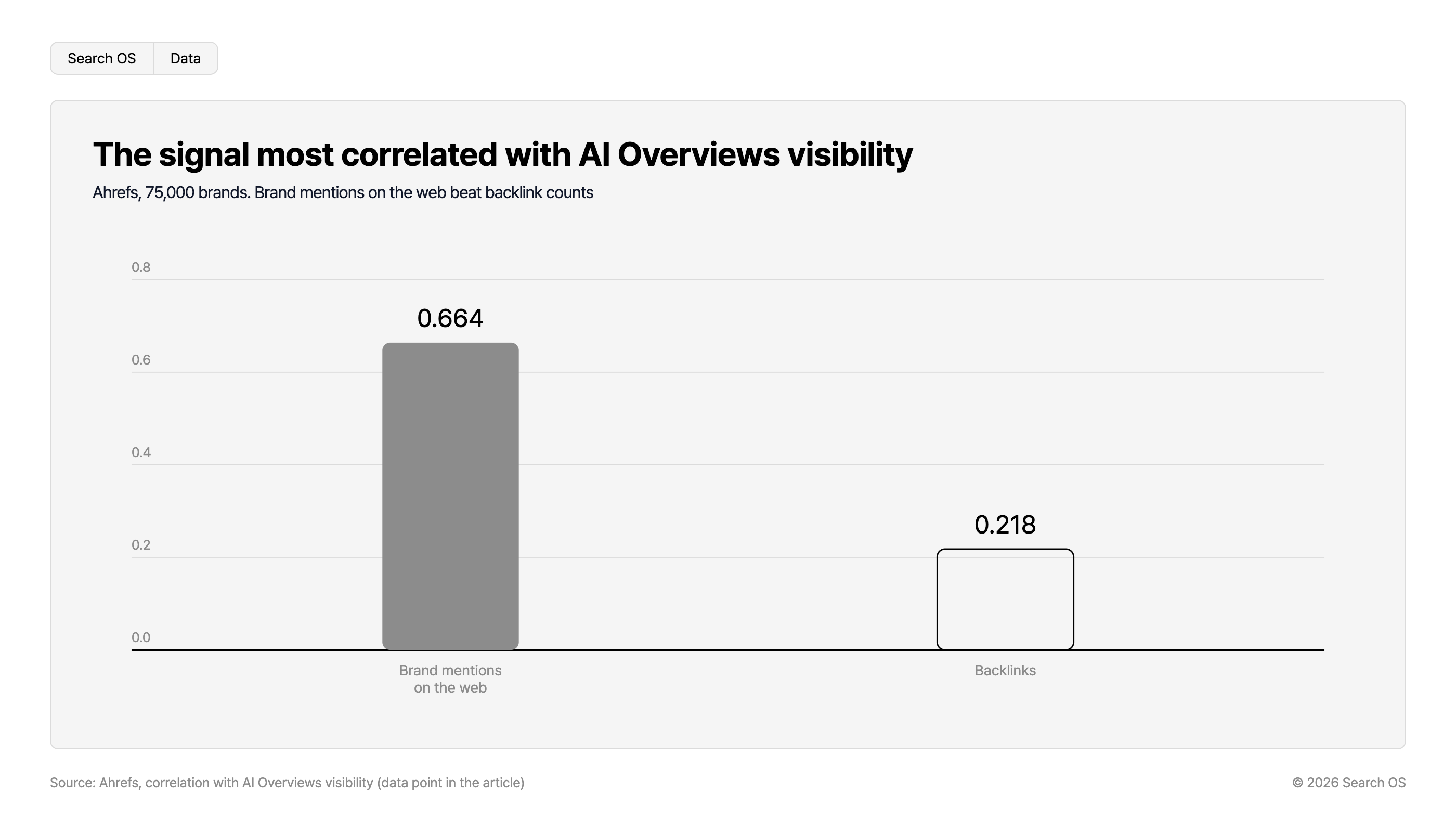
Data point: In an Ahrefs study analyzing 75,000 brands, the signal most strongly correlated with exposure in AI Overviews was not backlink count (0.218) but brand mentions across the web (0.664).
Navigation
- Search OS
- Data
The signal most correlated with AI Overviews visibility
Ahrefs, 75,000 brands. Brand mentions on the web beat backlink counts
| Signal | Correlation Value |
|---|---|
| Brand mentions on the web | 0.664 |
| Backlinks | 0.218 |
Source: Ahrefs, correlation with AI Overviews visibility (data point in the article)
© 2026 Search OS
How to build the dedicated page
Make each heading (h2) a question and write the answer directly under it. The first sentence answers the question.
"Can I cancel the subscription" → Answer: yes / yes with conditions. The conditions in one sentence
"What is the minimum number of deliveries" → Answer: the number. If there is no minimum, "none"
"By when do I need to give notice to cancel" → Answer: N days before the next shipping date
"How can I cancel" → Answer: My Page / phone / email. The hours for each
"Is there a cancellation fee" → Answer: yes / no. The amount if yes
"Can I change the delivery interval or skip a delivery" → Answer: what is allowed
After each answer, summarize the terms in a table.
Item | Content |
|---|---|
Minimum deliveries | (e.g.) None / 3 |
Cancellation deadline | (e.g.) 10 days before the next shipping date |
Cancellation method | My Page / phone (hours) / email |
Cancellation fee | (e.g.) None |
First-order special price conditions | Price from the second order, relation to the minimum-delivery requirement |
Placement and linking
A link to "Subscription terms" near the subscription option on the product page
The same link on the checkout confirmation screen
Next to the "Specified Commercial Transactions Act notice" in the footer
Cross-links from the Act notice page to this page and back
If the product page doesn't link to it, AI can't connect the product with the terms. Place the link next to the subscription option on the product page.
Legal alignment
The Specified Commercial Transactions Act requires subscription terms (count, total, cancellation conditions) to be displayed clearly on the final confirmation screen of the order. The dedicated page doesn't replace this disclosure obligation. It supplements it. Check that the terms are word for word the same in all three places: the final confirmation screen, the Act notice page, and the dedicated page. If the wording differs across the three, AI detects the contradiction and trusts none of them.
After the dedicated page is built
Terms change. You drop the minimum-delivery requirement. You change the cancellation deadline. You stop taking phone cancellations and move to My Page only. Unless all three places are updated at the same time each time, contradictions appear. A contradictory page drops out of AI's sources, and the citation goes back to the review site.
Search OS continuously checks, for shops selling subscriptions including on ecforce, that the terms page, the Act notice page, and the product page match, that structured data is correct, and that AI crawlers are actually fetching these pages. Contradictions and missed fetches are organized as fixes to make. It is not the work of deciding the terms. Decide in advance who keeps watching that the terms you set match on every page.
Frequently asked questions
Won't making cancellation terms prominent increase cancellations?
Complaints, chargebacks, and worsening reviews caused by unclear terms cost more. Clear terms reduce pre-purchase anxiety and support the first purchase.
Should I add FAQPage structured data to the dedicated page?
Google has effectively restricted FAQ rich results for general sites. The one-to-one structure of heading and body works better than structured data. Adding it does no harm, but the priority is low.
Can I get the review site citation removed?
No. The only way is to raise your citation priority by having your own page answer more structurally.
Related reading
References
Consumer Affairs Agency: Specified Commercial Transactions Act guide: mail order sales
Google Search Central: Creating helpful, reliable, people-first content
Google Search Central: AI features and your website