ecbeing: SEO and AI Search Requirements to Write into the RFP
Tags
- Search OS
- ecbeing
ecbeing: SEO and AI Search Requirements to Write into the RFP
| Category | Read Time | Topic | Source |
|---|---|---|---|
| Guides | 7 min read | Japan EC platform guides for search and AI search | Search OS |
With a large package like ecbeing, changing a requirement you left out of the RFP after the build is hard. This article covers six areas, URL design, rendering method, metadata management, structured data, bot access control, and log provision, in order of how hard they are to change later, with requirement wording you can paste into the RFP.
- URL
- searchos.io/en/blog
- Copyright
- © 2026 Search OS
When an ecommerce site is built on a large package like ecbeing, the SEO requirement in the RFP sometimes ends with a single line: "must be supported."
What you should write are the items you can't change after the build. Rendering is the process by which the browser assembles the screen. On a large package, changing the URL design, the rendering method, or the way metadata is managed afterward is work on the scale of a site move. Content and individual meta tags, on the other hand, can be changed later. Whatever isn't in the RFP follows the package default. The default doesn't necessarily match the buyer's requirements.
This article lays out requirements for six areas, ordered by how hard they are to change after the build, in wording you can paste into the RFP.
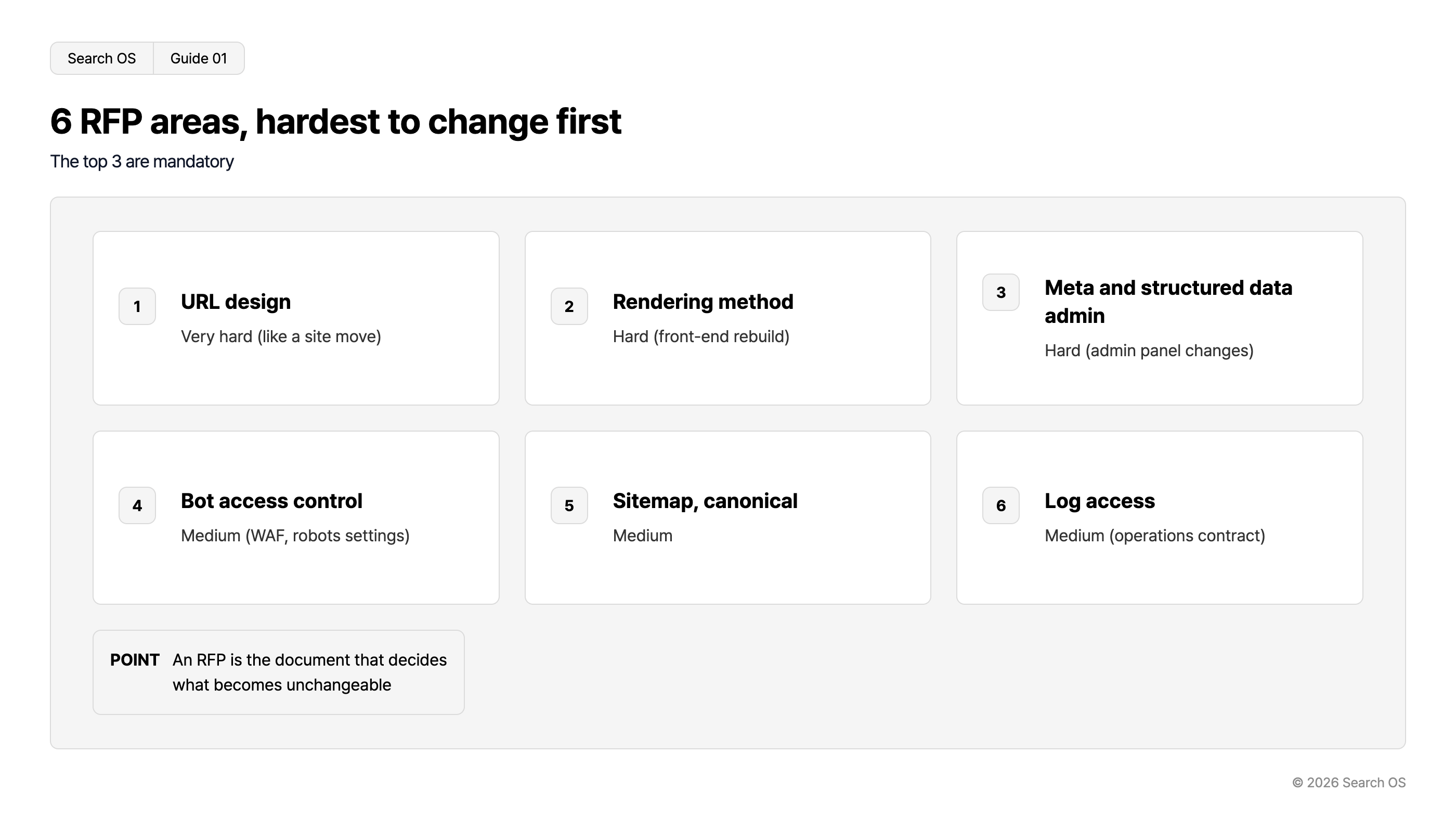
Conclusion: Six areas, in order of what can't be changed. Always write the top three
Rank | Area | Changing after the build | If left out of the RFP |
|---|---|---|---|
1 | URL design | Extremely hard (equivalent to a site move) | Package-default URLs. May be parameter-based or ID-only |
2 | Rendering method | Hard (front-end rebuild) | With client-side rendering, AI crawlers can't read the content |
3 | Metadata and structured data management | Hard (admin panel changes) | Not configurable from the admin panel; every change is a development request |
4 | Bot access control | Medium (WAF and robots settings) | Default WAF settings block crawlers |
5 | Sitemap and canonical | Medium | Default generation rules don't match requirements |
6 | Log provision | Medium (operations contract) | No way to check what bots are fetching |
Navigation
- Search OS
- Guide 01
6 RFP areas, hardest to change first
The top 3 are mandatory
| Order | Area | Difficulty |
|---|---|---|
| 1 | URL design | Very hard (like a site move) |
| 2 | Rendering method | Hard (front-end rebuild) |
| 3 | Meta and structured data admin | Hard (admin panel changes) |
| 4 | Bot access control | Medium (WAF, robots settings) |
| 5 | Sitemap, canonical | Medium |
| 6 | Log access | Medium (operations contract) |
- POINT
- An RFP is the document that decides what becomes unchangeable
© 2026 Search OS
Key idea: An RFP is not a document that says what you want done. It decides what will become unchangeable. Items that can't be changed after the build can only be decided before it. Write those items out first.
Area 1: URL design
Requirements to write in the RFP:
Product, category, and content URLs use path format, not parameters
A product URL identifies the product uniquely and does not change when its category changes
Category URLs reflect the hierarchy, and redirects on hierarchy changes can be set from the admin panel
Trailing slashes and letter case are standardized, and non-canonical forms redirect
When migrating from the old site, 301 redirects from old to new URLs can be set in bulk from a mapping table
The proposal must state the canonical rules for parameterized URLs (sorting, filtering, pagination)
Area 2: Rendering method
Requirements to write in the RFP:
Data point: A Korean ecommerce brand with roughly ₩40 billion (about ¥4 billion) in annual revenue set up its foundation in a separate rendering layer without changing the original code, and grew organic purchase revenue from about ₩92 million to about ₩166 million (+80%) in three months.(case study)
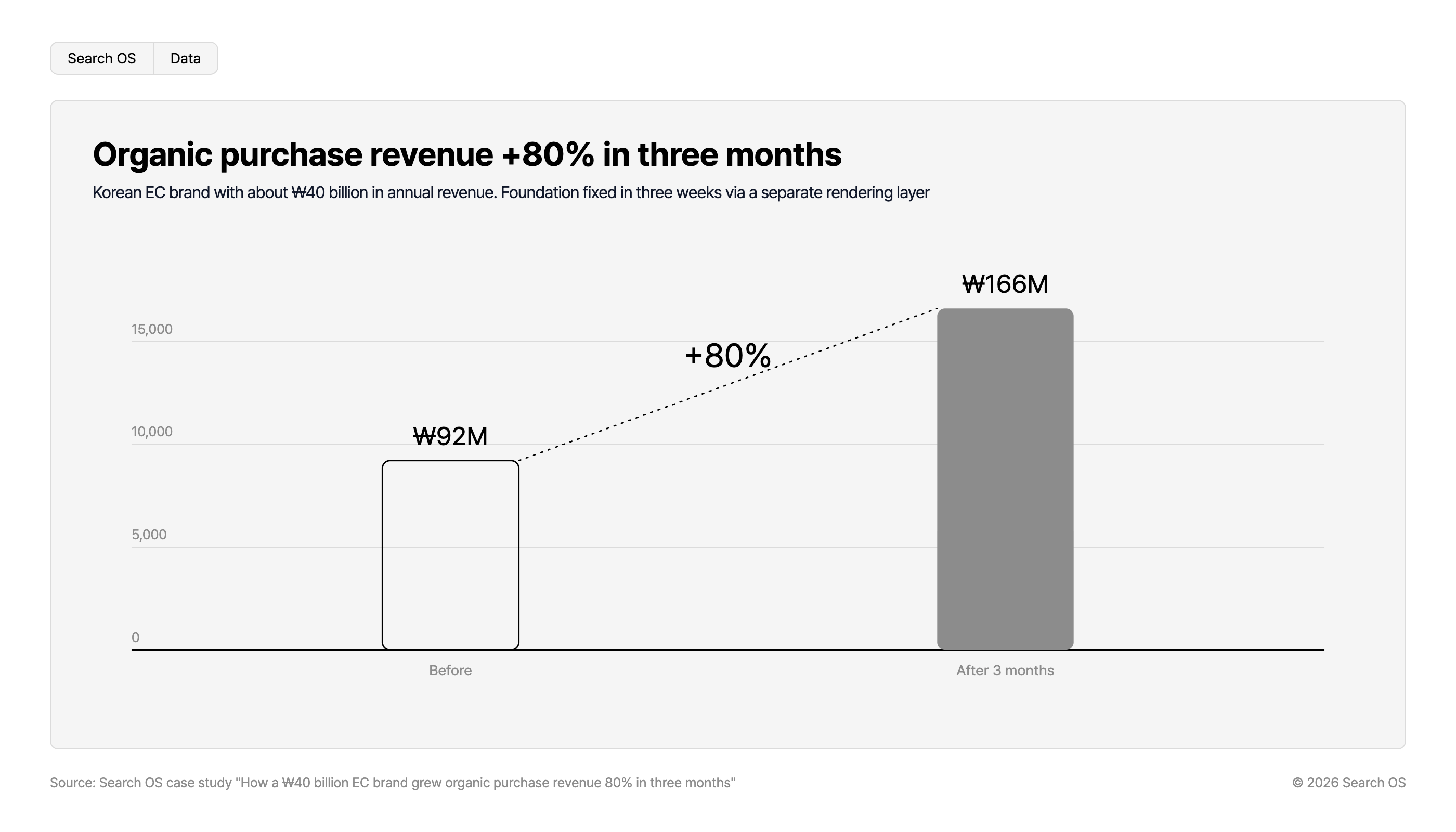
Organic purchase revenue +80% in three months
Korean EC brand with about ₩40 billion in annual revenue. Foundation fixed in three weeks via a separate rendering layer
| Period | Revenue | Growth |
|---|---|---|
| Before | ₩92M | |
| After 3 months | ₩166M | +80% |
Source: Search OS case study "How a ₩40 billion EC brand grew organic purchase revenue 80% in three months"
© 2026 Search OS
Product name, price, stock, product description, breadcrumbs, and structured data must be included in the HTML response without executing JavaScript (server-side rendering or static generation)
If client-side rendering is adopted, include a mechanism that returns equivalent HTML server-side for search engines and AI crawlers
Attach to the proposal an HTML sample of a product page with JavaScript disabled
Most AI crawlers don't execute JavaScript. To AI, a client-side-rendered site looks like a page with nothing on it. This is the hardest item to change after the build, so the rendering requirement goes in at the RFP stage.
Area 3: Metadata and structured data management
Requirements to write in the RFP:
title, meta description, canonical, noindex, and OGP can be set per product, category, and content item from the admin panel
The template (auto-generation rule) used when nothing is set can be changed per page type from the admin panel
Product, BreadcrumbList, Organization, and Article structured data are output dynamically from product data. The proposal must state which attributes are output
Structured data output can be enabled and disabled from the admin panel without development
The same structured data type is never output twice on one page
Area 4: Bot access control
Requirements to write in the RFP:
WAF, bot protection, and rate limiting include the verified IPs of search engines and AI crawlers in the allowlist. The allowlist update procedure is included in the operations manual
robots.txt can be edited from the admin panel or without a deployment
Allowing or denying AI crawlers (GPTBot, ClaudeBot, PerplexityBot, etc.) can be set per crawler in robots.txt
Area 5: Sitemap and canonical
Requirements to write in the RFP:
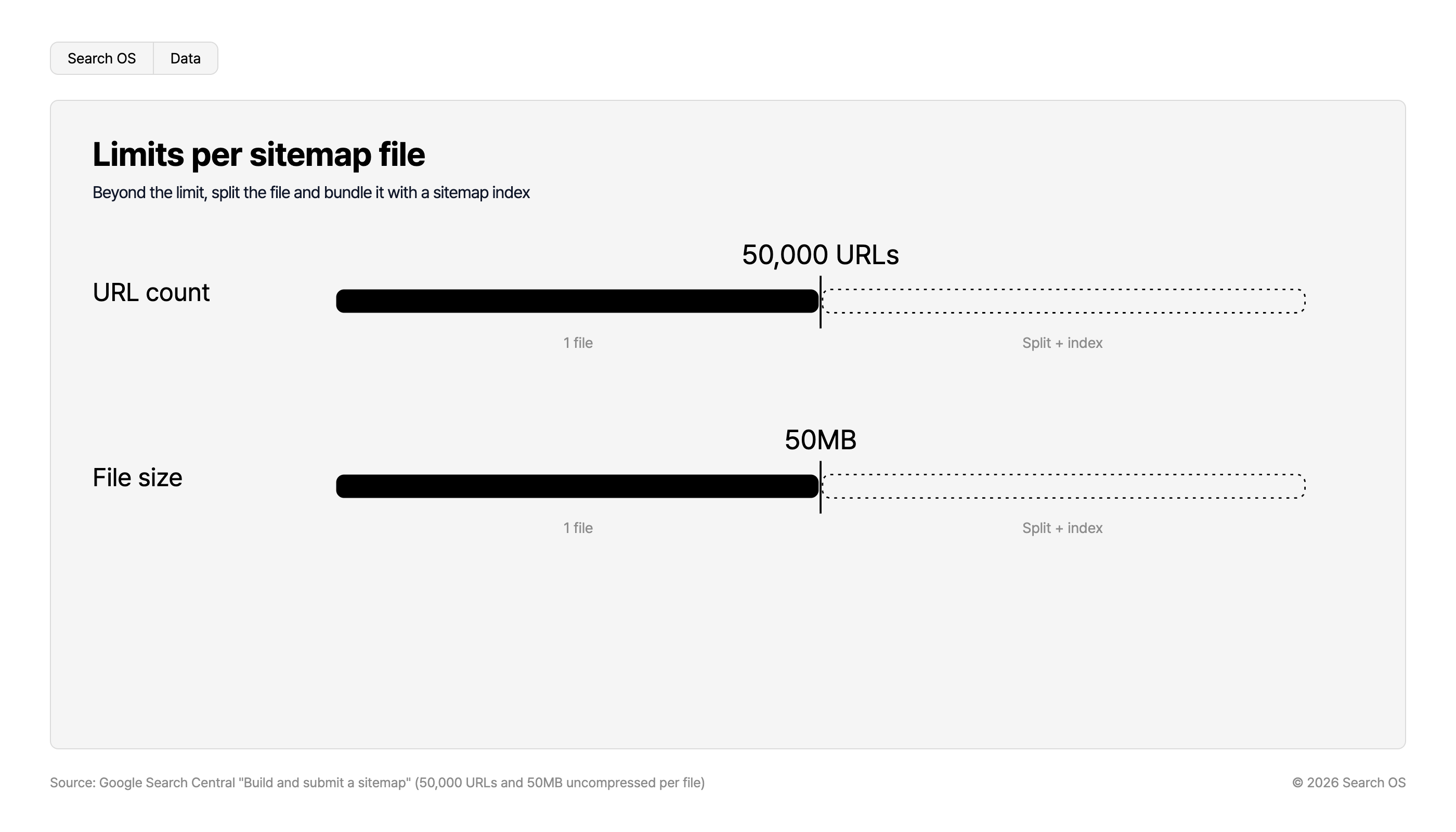
Limits per sitemap file
Beyond the limit, split the file and bundle it with a sitemap index
| Metric | Limit (1 file) | Beyond Limit |
|---|---|---|
| URL count | 50,000 URLs | Split + index |
| File size | 50MB | Split + index |
Source: Google Search Central "Build and submit a sitemap" (50,000 URLs and 50MB uncompressed per file)
© 2026 Search OS
The XML sitemap is generated automatically, includes products, categories, and content, and excludes unpublished and discontinued items. lastmod reflects the update time
Split at more than fifty thousand URLs and output a sitemap index
Every page outputs a canonical, and parameterized URLs follow the rules in Area 1
Area 6: Log provision
Requirements to write in the RFP:
The buyer can retrieve web server or CDN access logs in a format that includes User-Agent, response code, URL, and timestamp
Log retention period and retrieval method are included in the operations manual
Only the logs tell you what bots are actually fetching. Without logs, you have no way to check how the site is doing in AI search. Write into the RFP that the buyer can retrieve logs themselves.
Acceptance conditions to attach to the RFP
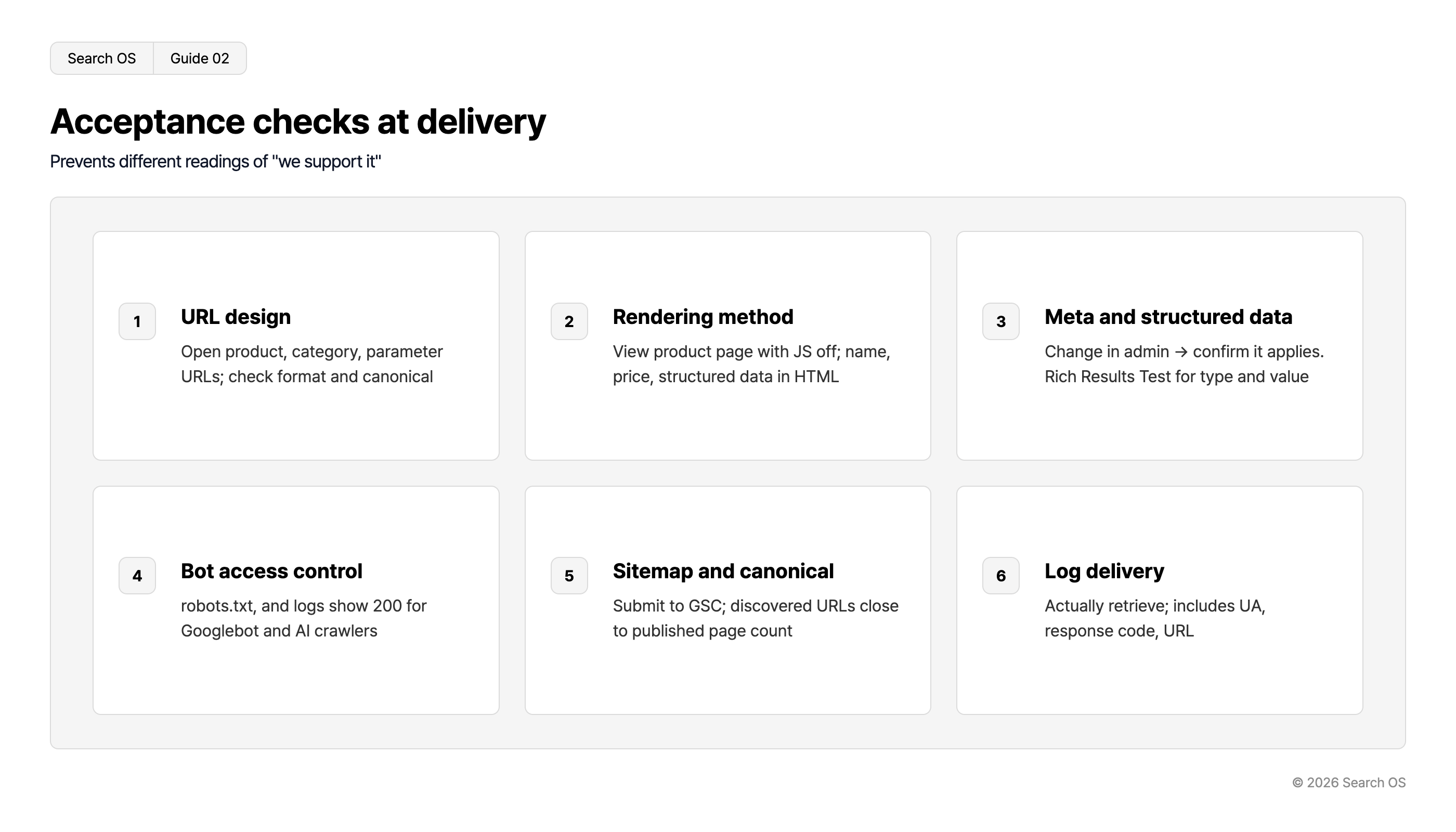
For each area, write "at delivery, the buyer will verify by the following method." With acceptance conditions in place, there is less room for "we will handle it" to be read differently.
Area | Acceptance method |
|---|---|
URL design | Open product, category, and parameterized URLs in a browser and check the format and canonical |
Rendering method | Display a product page with JavaScript disabled and confirm the product name, price, and structured data are in the HTML |
Metadata and structured data | Change a setting in the admin panel and confirm it appears on the page. Check types and values with the Rich Results Test |
Bot access control | Check the contents of robots.txt and confirm in server logs that Googlebot and AI crawlers receive a 200 response |
Sitemap and canonical | Submit the sitemap to Search Console and confirm the discovered URL count is close to the number of published pages |
Log provision | Actually retrieve the logs and confirm they include User-Agent, response code, and URL |
Navigation
- Search OS
- Guide 02
Acceptance checks at delivery
Prevents different readings of "we support it"
| Step Number | Title | Description |
|---|---|---|
| 1 | URL design | Open product, category, parameter URLs; check format and canonical |
| 2 | Rendering method | View product page with JS off; name, price, structured data in HTML |
| 3 | Meta and structured data | Change in admin → confirm it applies. Rich Results Test for type and value |
| 4 | Bot access control | robots.txt, and logs show 200 for Googlebot and AI crawlers |
| 5 | Sitemap and canonical | Submit to GSC; discovered URLs close to published page count |
| 6 | Log delivery | Actually retrieve; includes UA, response code, URL |
© 2026 Search OS
The work that remains after the build
An RFP can only guarantee the state at build time. Feature additions, package version upgrades, and WAF setting changes after that erode the state the requirements described. Check whether the maintenance contract includes maintaining the requirements and verifying them on every change.
Search OS continuously verifies the state corresponding to these six areas on sites built on large packages such as ecbeing. Items that have drifted since the build, and changes in what bots fetch, are organized as fixes to make. It is not the layer that does the build. Decide at the contract stage who keeps watching the requirements after the build.
Frequently asked questions
If I write this much into the RFP, will vendors stop submitting proposals?
An RFP with clear requirements is an easier document for vendors to estimate. If there are items they can't handle, the proposal shows an alternative. Leaving things unwritten causes disputes later.
Can I leave the rendering method to the vendor?
If you do, you get whatever method the vendor is best at. If AI search matters to you, write server-side rendering as a requirement.
Isn't log provision a given?
Depending on the operations contract, logs may sit on the vendor's side where the buyer can't retrieve them directly. Write it into the RFP.
Related reading
How to Design URLs and Redirects for a Large-Scale ecbeing Renewal
A Requirements Template for Briefing Your EC-CUBE Agency on SEO and AI Search
SEO and AI Optimization for SI-Built Sites: How to Move Forward Without a Development Cycle
References
Google Search Central: JavaScript SEO basics
Google Search Central: URL structure best practices
Google Search Central: Ecommerce best practices
Google Search Central: Verifying Googlebot and other Google crawlers